Phone: +966-50-7024644 | Email: info@ghalibconsulting.com

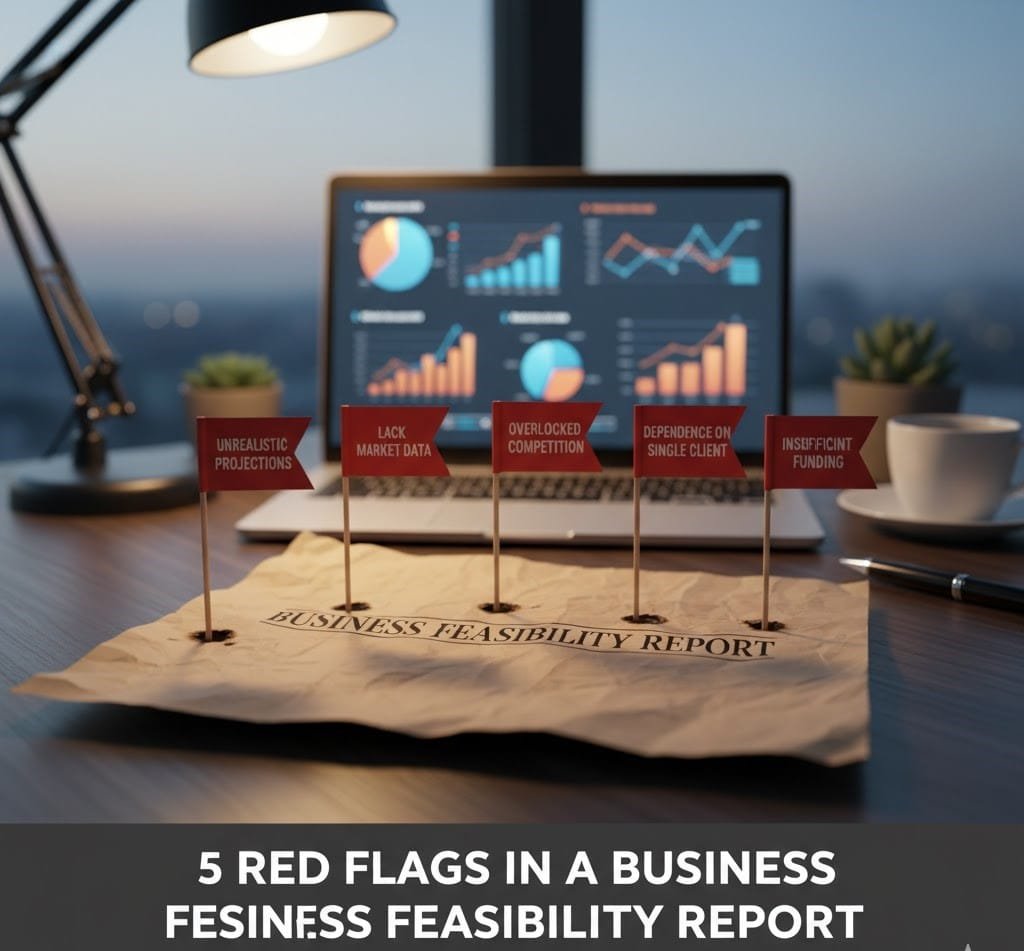

Table of Contents
5 Red Flags in a Business Feasibility Report You Should Never Ignore
I’ll never forget the confident entrepreneur who walked into our office with a 100-page feasibility report. He was ready to invest millions in a new tech venture in Riyadh. The report was glossy, professionally bound, and full of promising charts. But as I turned the pages, my heart sank.
Buried in the appendix was a single, devastating assumption: the projected customer acquisition cost was 90% lower than the regional industry average. The entire business case was a house of cards, doomed to collapse upon contact with reality.
That investor avoided a multi-million dollar mistake because he knew what to look for.
In the dynamic, ambitious economies of the UAE and Saudi Arabia, a feasibility study is your first line of defence. It’s the document that separates a visionary opportunity from a financial nightmare. But not all reports are created equal. A flawed report is more dangerous than no report at all—it gives you a false sense of security.
Having analysed hundreds of these reports for projects from Dubai to Jeddah, I’ve seen the same critical warning signs appear again and again. Here are the 5 red flags in a business feasibility report that you should never, ever ignore.
Red Flag #1: Vague or Overly Optimistic Market Size Analysis
The report opens with a grand statement: “The total addressable market for our product in Saudi Arabia is $5 billion.” It sounds impressive, but it’s often a meaningless number designed to dazzle rather than inform.
Why It’s a Red Flag:
This is known as the “1% of a huge market” fallacy. A report that focuses on the total market (TAM) without rigorously defining your serviceable available market (SAM) and serviceable obtainable market (SOM) is built on sand. It assumes you can effortlessly capture a slice of a massive pie without considering competition, regulatory barriers, or customer readiness.
What to Look For Instead:
A credible report will be specific and grounded. It should:
- Define the Target Customer Precisely: Not “businesses in Dubai,” but “SMEs with 50-200 employees in the DIFC with annual software budgets exceeding $50,000.”
- Use Bottom-Up Analysis: The methodology should build the market estimate from specific data points (e.g., number of potential customers x average revenue per user), not just top-down industry reports.
- Acknowledge Competition: It must explicitly name key competitors and justify your proposed market share.
A vague market size is the foundation of a fantasy, not a business plan.
Red Flag #2: Weak or Non-Existent Competitor Analysis
I once reviewed a report for a new F&B concept in Abu Dhabi that claimed it had “no direct competitors.” This is almost never true. Every business has competition, even if it’s the status quo or a substitute product.
Why It’s a Red Flag:
Ignoring competitors signals a profound lack of market understanding. In crowded sectors like real estate, retail, and tech in the UAE and KSA, this is suicidal. It shows the analysts haven’t left their desks to truly understand the landscape. According to a foundational business strategy framework like Porter’s Five Forces, understanding rivalry and substitutes is crucial for profitability.
What to Look For Instead:
A robust report will include a detailed competitor matrix, analysing:
- Direct Competitors: Their pricing, strengths, weaknesses, and market share.
- Indirect Competitors: Alternative solutions customers might use.
- Barriers to Entry: What will stop competitors from immediately copying your success?
| Competitor | Key Strength | Key Weakness | Our Proposed Advantage |
|---|---|---|---|
| Competitor A | Brand Recognition | High Pricing | 20% Cost Savings |
| Competitor B | Wide Distribution | Poor Customer Service | Superior After-Sales Support |
Red Flag #3: Financial Projections That Are “Too Perfect”
Humanity has yet to invent a business that experiences only smooth, exponential growth. If the revenue line in your feasibility report is a perfect, unwavering curve upward, be very suspicious.
Why It’s a Red Flag:
Life—especially business life—is messy. “Too perfect” projections lack seasonality, don’t account for launch delays, and ignore the inevitable operational hiccups. They often rely on best-case scenarios for every single assumption. A study by the Harvard Business Review on commercial forecasting found that over-optimism is one of the most common causes of project failure.
What to Look For Instead:
Demand to see a sensitivity analysis. This is non-negotiable. A professional report will show you how your key metrics (like NPV or IRR) change if your main assumptions (e.g., sales volume, material costs) are 10-20% worse than expected.
It should also present at least three scenarios:
- Base Case: The most likely outcome.
- Optimistic Case: The best-case scenario.
- Pessimistic Case: A conservative, worst-case scenario.
This shows the analysts have stress-tested the idea and are prepared for reality.
Red Flag #4: Underestimating Logistical & Regulatory Costs
This is a particularly critical red flag for the UAE and KSA markets. A report might beautifully calculate the cost of goods sold but completely overlook the cost and complexity of VAT compliance in the UAE, navigating Saudi Arabian customs, or securing a specific municipality license.
Why It’s a Red Flag:
These “hidden” costs can obliterate your margins. The regulatory environment in the Gulf is sophisticated and evolving rapidly, especially with initiatives like Saudi Vision 2030. Underestimating them shows a lack of local expertise and on-the-ground experience. A report written by someone without direct regional knowledge is a recipe for unpleasant surprises.
What to Look For Instead:
The report must have a dedicated section on regulations and logistics. It should:
- List all required licenses and permits with estimated costs and timelines.
- Detail the supply chain, identifying potential bottlenecks.
- Include a risk register that specifically addresses regulatory changes.
Red Flag #5: The Assumptions Section is Missing or Thin
The heart of any feasibility report is not its conclusion, but its “Assumptions” section. This is where the authors must lay their cards on the table. If this section is brief, vague, or missing altogether, close the report and walk away.
Why It’s a Red Flag:
Every projection is built on a foundation of assumptions. If those assumptions are hidden, you cannot judge the validity of the conclusions. It’s like a chef refusing to share the recipe—you have to just trust that the meal is good. In business, blind trust is expensive.
What to Look For Instead:
A high-quality report will have a detailed, clearly labeled assumptions section. Key assumptions to scrutinize include:
- Customer acquisition cost and conversion rates.
- Average revenue per user/customer.
- Inventory days and accounts receivable periods.
- Local wage rates and employee turnover assumptions.
- Inflation and cost escalation rates.
Your Next Step: From Red Flags to Green Lights
A feasibility report should be a tool for de-risking your investment, not a sales pitch for a pre-determined idea. By learning to spot these 5 red flags in a business feasibility report, you empower yourself to ask the right questions and demand the rigour your investment deserves.
At Ghalib Consulting, we don’t just produce reports that tell you what you want to hear. We build data-driven, critically stress-tested feasibility studies grounded in the realities of the UAE and Saudi Arabian markets. We challenge our own assumptions so you can invest with confidence.
Don’t let a flawed report dictate your future.