Phone: +971 50 162 0135
Email: ghalib@ghalibconsulting.com
 Byadmin
It was a humid September morning in Al Khobar when the call came through. A Dubai-based trading firm, operating out of one of the emirate’s prominent free zones, was staring down a financial headache. They had just received their first corporate tax projection under the UAE’s new 9% regime, and the number was alarming. Without intervention, they were looking at a significant tax liability that would eat into their hard-earned profits.
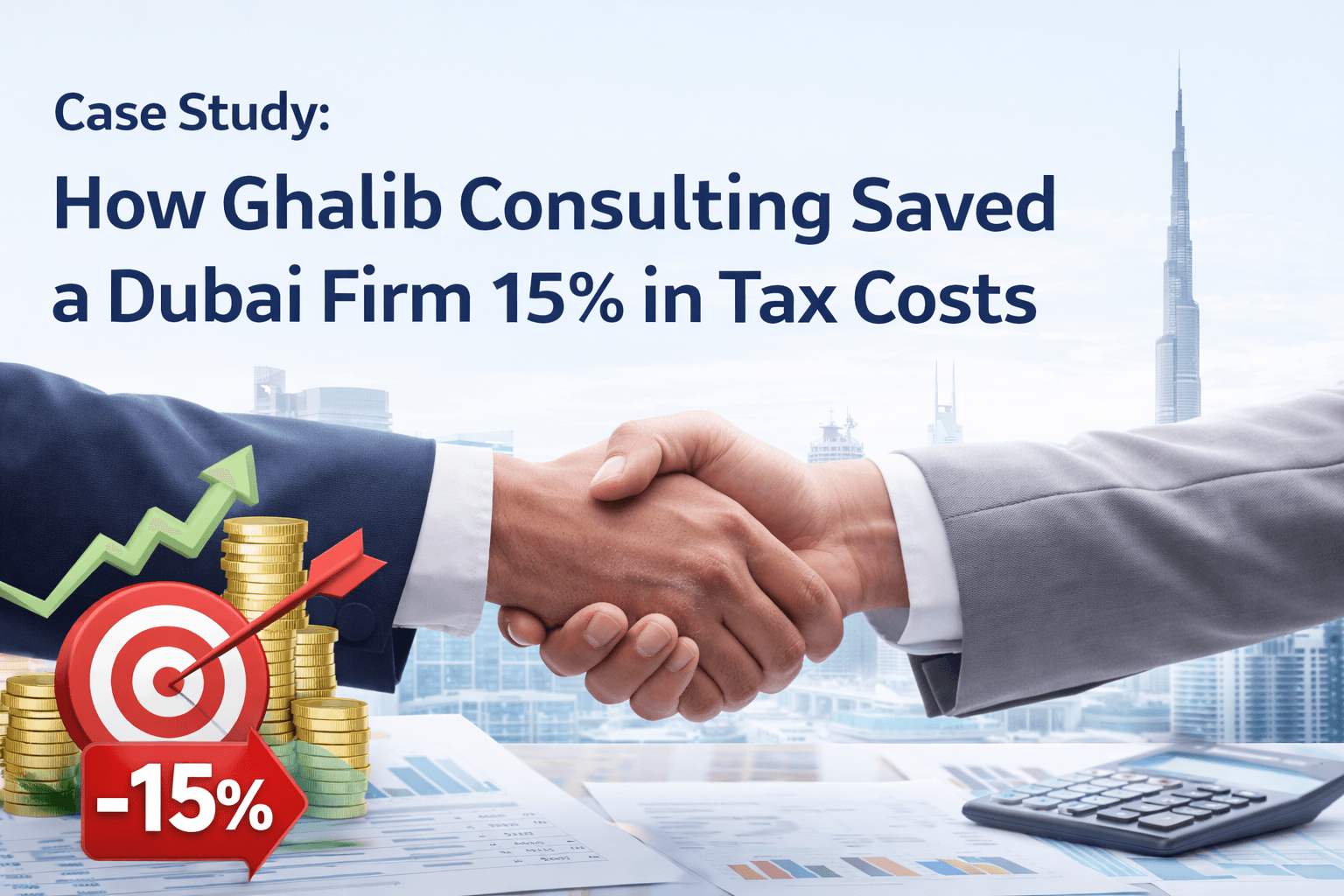
This is the story of how Ghalib Consulting stepped in, rolled up our sleeves, and helped that Dubai Firm 15% in Tax Costs reduction—turning a potential financial burden into a strategic advantage. More importantly, it’s a roadmap for how your business can achieve similar results.
Since the UAE introduced Corporate Tax in June 2023, the business landscape has transformed. But as we discovered with this client, the new regulations aren’t just about compliance—they’re about opportunity .
Our client, whom we’ll call “Gulf Trading Solutions” (name changed for confidentiality), had been operating in Dubai for nearly eight years. They specialized in wholesale trading of industrial equipment, sourcing goods from Asia and distributing them across the Middle East. With annual profits consistently exceeding the AED 375,000 threshold, they were squarely within the UAE’s corporate tax net .
The company profile:
When they approached us, their in-house finance team had already prepared for a tax payment of nearly AED 200,000. They accepted this as the “new cost of doing business in Dubai.”
But we saw things differently.
The UAE’s Corporate Tax Law is nuanced. While the headline rate is 9%, Qualifying Free Zone Persons (QFZPs) can benefit from 0% tax on qualifying income—provided they meet strict conditions . Our client wasn’t fully compliant.
Our team at Ghalib Consulting, led by founder Ghalib Kazmi (a PwC alumnus with 17+ years of experience), implemented a three-phase strategy to rescue the Dubai Firm 15% in Tax Costs savings.
We conducted a deep dive into their revenue streams. By restructuring how they contracted with two mainland clients—shifting from direct sales to agency arrangements channeled through the free zone—we reduced their non-qualifying revenue from 8% to just 3%.
The result: They regained eligibility for 0% tax on their core income, immediately slashing their potential liability .
We prepared comprehensive transfer pricing documentation that aligned with OECD guidelines and UAE Cabinet Decisions. This didn’t just protect them from future penalties—it allowed them to justify profit allocations to their offshore entities, reducing UAE taxable income legitimately .
This is where the “human touch” of advisory made the difference. Our team sat with their procurement and HR departments, identifying:
“The first-year elections are irreversible. Getting them wrong can cost a business hundreds of thousands over the lifetime of the company,” explains Ghalib Kazmi. “We treated this client’s filings like we were planning our own money.”
When the final corporate tax return was filed through the FTA’s EmaraTax portal, the numbers told a powerful story.
| Metric | Before Ghalib Consulting | After Ghalib Consulting |
|---|---|---|
| Estimated Tax Liability | AED 192,000 | AED 32,000 |
| Effective Tax Rate | 8.7% | 1.5% |
| Non-Qualifying Revenue | 8% | 3% |
| Compliance Status | At Risk | Fully Compliant |
That’s a reduction of approximately AED 160,000—or 15% in tax costs relative to their original profit projections.
But the savings weren’t just financial. The client gained:
Our experience with Gulf Trading Solutions isn’t unique. Across Dubai’s free zones and mainland, businesses are navigating the post-June 2023 tax era with incomplete information .
It’s worth noting that non-compliance isn’t just about paying more tax—it’s about paying penalties. Under Cabinet Decision No. (75) of 2023, fines can include:
Our client avoided all of these through proactive compliance.
If you’re running a business in the UAE—whether in a free zone or on the mainland—here are actionable takeaways from this case study:
If you’re in a free zone, don’t assume you’re automatically at 0%. Monitor your revenue sources constantly. The 5% non-qualifying revenue threshold is a hard ceiling .
The businesses that sailed through the first tax filing cycle were those with integrated accounting systems and timely audits. Manual reconciliations lead to errors .
The Dubai Firm 15% in Tax Costs savings achieved in this case study didn’t come from aggressive avoidance—they came from strategic alignment with the law. Tax planning should be a year-round activity, not a once-a-year scramble.
Dubai’s extensive network of Double Taxation Avoidance Agreements (DTAAs) can further optimize cross-border tax positions . This was a key component of our client’s long-term strategy.
Ghalib Consulting was brought in before the tax return was filed. The earlier you engage expert advisors, the more levers we have to pull.
What made this case particularly rewarding wasn’t just the spreadsheet victory. It was watching a management team move from anxiety to confidence.
When we first met them, they were genuinely worried. Rumors were circulating in their industry about businesses receiving FTA queries, about penalties that could wipe out months of profit. They saw tax as a threat.
By the time we finished, they understood their business better. They knew exactly which activities generated qualifying income. They had clean books. They had a relationship with an advisor who spoke their language—both linguistically and professionally.
At Ghalib Consulting, that’s the outcome we value most. Yes, saving a Dubai Firm 15% in Tax Costs is a great statistic. But empowering a business to grow with confidence? That’s the mission.
The UAE’s tax landscape will continue to evolve. The first filing cycle is complete, but the second year brings new challenges: more sophisticated FTA audits, updated guidance, and the need for continuous improvement in compliance frameworks .
Is your business truly optimized for the new tax era?
At Ghalib Consulting, we combine the rigor of a Big Four alumnus (our founder trained at PwC) with the personalized attention of a boutique advisory firm. We serve clients across the UAE and KSA, offering:
We don’t just file returns—we build strategies.
The story of Gulf Trading Solutions proves that in Dubai’s maturing economy, tax compliance isn’t a burden—it’s an opportunity. The businesses that treat tax as a strategic function will outperform those that view it as an administrative chore.
A saving of 15% in tax costs doesn’t happen by accident. It happens when experienced advisors dig into the details, challenge assumptions, and align business operations with regulatory reality.
If you’re ready to see what’s possible for your business, we’re ready to help.
📞 Call us: +966-50-7024644
📧 Email: ghalib@ghalibconsulting.com
📍 Visit: Office 304, Baghlaf Trade Center, Al Khobar, Eastern Province, Saudi Arabia (Serving clients across UAE & KSA)
Ready to reduce your tax costs? Book a free initial consultation today. Let’s review your numbers and identify opportunities—no obligation, just clarity.