Phone: +971 50 162 0135
Email: ghalib@ghalibconsulting.com

 Byadmin
The coffee tastes bitter. There is an official envelope on your desk with the unmistakable logo of the Federal Tax Authority (FTA).
For many business owners in the UAE, this moment triggers a wave of anxiety. We immediately think of fines, legal teams, and endless hours digging through old invoices. But what if I told you that receiving an audit notice doesn’t have to be a crisis? In fact, for the prepared business, it can be a routine—and even affirming—process.
Since the introduction of VAT in 2018 and the recent rollout of Corporate Tax, the Federal Tax Authority has matured into a world-class regulatory body. Their audits aren’t about “catching you out”; they are about ensuring the fairness and accuracy of the tax system .
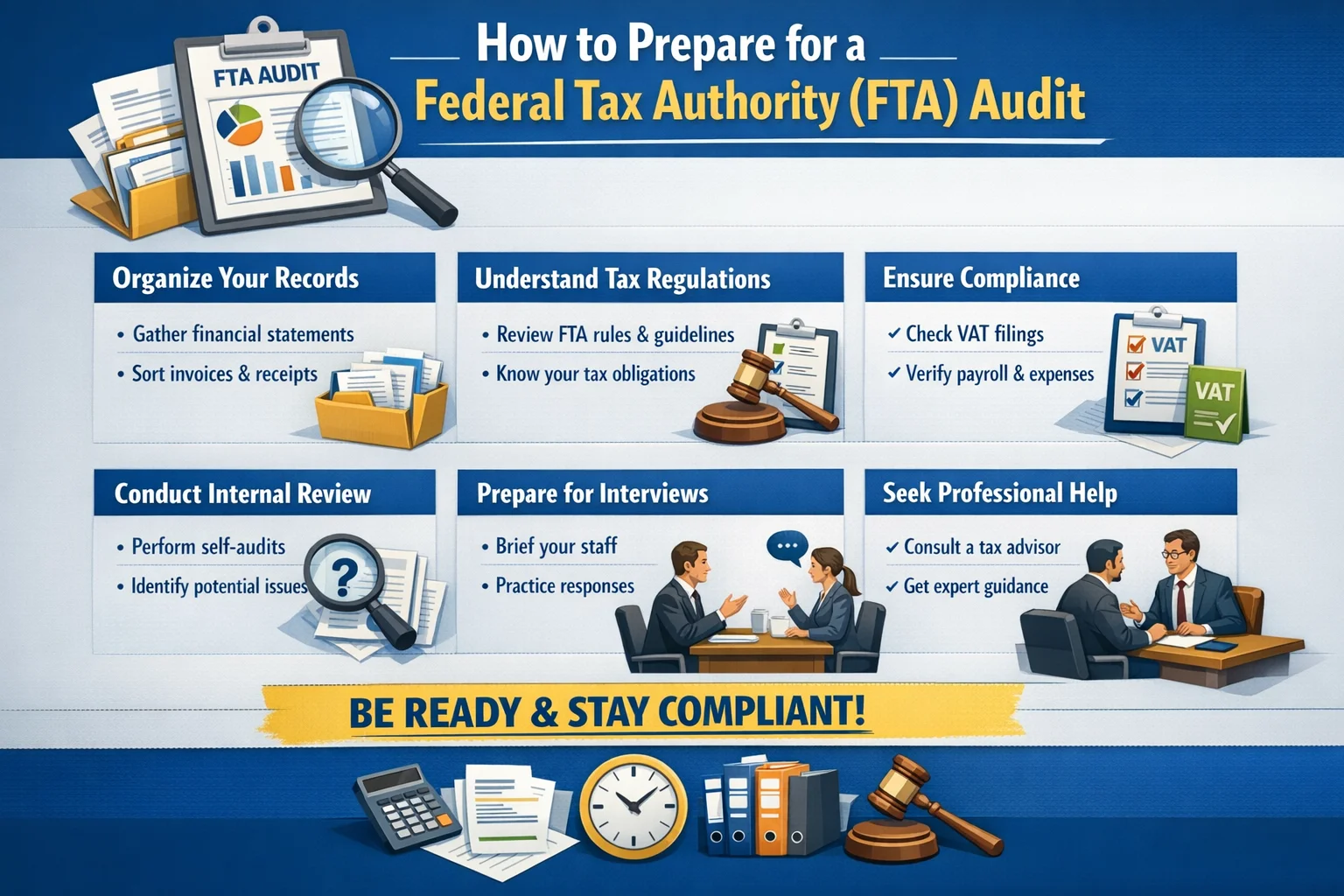
Having guided numerous clients through the granite and glass of Dubai and the bustling industrial zones of Riyadh, I’ve learned one truth: The audit is won or lost long before the letter arrives. Here is your roadmap to facing the FTA not with fear, but with confidence.
Before we dive into spreadsheets and ledgers, we need to understand the mindset of the auditor. The FTA isn’t looking for perfection; they are looking for substance.
In the UAE, there are generally two types of audits: the Desk Audit (where you submit documents remotely) and the Field Audit (where officers visit your premises) . Contrary to popular belief, an audit trigger isn’t always a mistake. Sometimes it’s random; sometimes, it’s because your numbers look “too good” compared to industry norms, or you’ve claimed a large refund .
However, the most common trigger? Inconsistency. If your VAT returns don’t tell the same story as your financial statements, or if your Corporate Tax filings don’t align with your Transfer Pricing documentation, the Federal Tax Authority will want to know why .
In the Middle East, business has always been built on trust and relationships. But in the world of tax, trust is verified by paper. The cornerstone of surviving an FTA audit is Document Retention.
The law requires you to keep records for five years (and 15 years for real estate transactions) . However, in practice, I advise my clients to think of it as a “living archive.”
What does that fortress look like?
One of the most frequent issues we see during FTA audits in our practice is the mishandling of the Reverse Charge Mechanism.
Imagine you are a tech startup in Dubai Internet City. You hire a software developer in the UK. You pay them, but you don’t see any VAT on their invoice. It’s tempting to assume no tax is due. Wrong.
Under the reverse charge, you are essentially the importer of that service. You must account for the VAT as if you sold it to yourself. Forgetting this is one of the quickest ways to rack up penalties . The Federal Tax Authority has sophisticated data-sharing agreements; they know about those cross-border payments.
The most successful businesses we work with don’t wait for the audit notice. They conduct a Pre-Audit Risk Assessment or a “VAT Health Check” .
Set aside a day—perhaps during a quiet month—to play devil’s advocate.
Here is where the human element comes in. We are all human, and humans make mistakes. Perhaps you accidentally double-claimed input VAT, or you miscalculated your zero-rating on exports.
If you discover the error before the Federal Tax Authority does, you have a powerful tool: Voluntary Disclosure .
Filing a Voluntary Disclosure (VD) shows the FTA that you have robust internal controls and integrity. While you will still likely pay the principal tax and a reduced penalty, a VD filed proactively is viewed far more favorably than trying to hide the error. Waiting for the auditor to find it invites higher penalties and a much deeper investigation.
The day arrives. The auditor is sitting in your conference room. Here is the secret the textbooks don’t tell you: Auditors are more comfortable with “organized” businesses.
If you dump a pile of unorganized receipts on the table and say “find what you need,” you are signaling chaos. Chaos invites scrutiny. Scrutiny finds issues.
Instead, present your documents with an index. Respond to their queries with specific references (“Please see Schedule A, Row 5, which supports the entry on VAT Return Q2 2024”). This professionalism does two things:
Once the audit concludes, you will receive the findings.
In the dynamic markets of the UAE and Saudi Arabia, tax compliance is no longer just an administrative chore; it is a marker of a mature, investment-ready business.
A business that can withstand the scrutiny of the Federal Tax Authority is a business that knows its numbers, controls its cash flow, and operates with integrity. That is the kind of business investors want to back, and the kind of business that scales successfully.
Don’t fear the audit. Prepare for it. Let it be the process that sharpens your financial management and sets you apart from the competition.
At Ghalib Consulting, we specialize in making the complex simple. Whether you need a Pre-Audit Health Check, assistance with Voluntary Disclosures, or ongoing Tax Compliance support in the UAE and KSA, our team is here to help you navigate the evolving tax landscape with confidence.
📞 Contact us today for a free, confidential consultation. Let’s ensure your next audit letter is met with a smile, not a sigh.