Phone: +971 50 162 0135
Email: ghalib@ghalibconsulting.com

 Byadmin
“Should I really spend money on a feasibility study before starting?”
I hear this question almost weekly from entrepreneurs sitting across my desk in Dubai. They’ve got the spark—the business idea that keeps them awake at night. They’ve done their napkin math. They’re ready to jump.
And my answer is always the same: A proper business feasibility study in Dubai isn’t an expense. It’s insurance.
Let me share why this matters more in 2026 than ever before.
Dubai closed 2025 with remarkable momentum. The emirate recorded AED 917 billion in real estate transactions, trade exports climbed 15.1%, and GDP growth hit 4.5%—well above global averages . Tourism brought 15.7 million visitors in the first ten months alone .
But here’s what the headlines don’t tell you: success attracts competition.
With over 140,000 active companies in the UAE and more than 45 free zones competing for investors , the era of “show up and succeed” is over. The market has matured. And maturity demands rigor.
A feasibility study answers one fundamental question: “Should this project exist?”
Not “can we build it?” but “should we build it?”
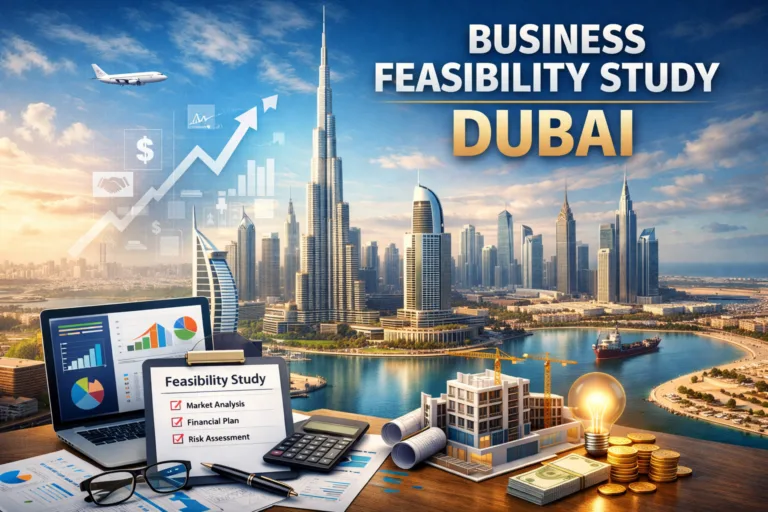
It’s the difference between falling in love with an idea and validating that the market loves it too. A proper study examines your concept from five critical angles :
The rules have changed. Three major shifts make feasibility studies non-negotiable this year.
February 2026 brought a significant procedural change: foreign corporate shareholders must now appoint a UAE-resident manager at incorporation for mainland companies . The manager’s Emirates ID is mandatory before applications begin.
This isn’t a minor paperwork tweak. It fundamentally changes how foreign entities structure their Dubai entry.
Corporate Tax at 9% on profits above AED 375,000 is fully enforced . VAT compliance is mandatory once turnover hits AED 375,000 . Free zone tax benefits require meeting “Qualifying Income” criteria and Economic Substance Regulations .
A feasibility study that ignores tax implications isn’t just incomplete—it’s dangerous.
In 2026, a trade license doesn’t guarantee a bank account. Banks scrutinize business plans, partner CVs, source of wealth, and expected transaction volumes . Without a credible feasibility study, your bank application stalls before it starts.
Let me walk you through what actually goes into a professional study.
This isn’t about Googling statistics. It’s about understanding who your customer really is.
Dubai’s market isn’t monolithic. Your target could be:
Each segment behaves differently. Each has distinct decision drivers. Your feasibility study must identify which segment you’re actually serving and whether it’s large enough to sustain your business.
This is where many DIY studies fail.
Dubai’s regulatory environment has layers :
A proper feasibility study maps these requirements before you commit capital.
Realistic financial modeling matters more than optimistic spreadsheets.
In 2026, with full tax enforcement, cash flow modeling must also account for:
Can you actually deliver what you’re promising?
Dubai’s infrastructure is world-class, but sector-specific requirements vary. A logistics business needs different facilities than a consultancy.
This isn’t pessimistic—it’s prudent.
Comprehensive risk analysis examines :
The goal isn’t to eliminate risk—it’s to understand it before it surprises you.
One question dominates every conversation: “What’s the minimum investment?”
Here’s the truth: Dubai doesn’t have a single minimum investment figure .
What it has is a minimum sustainable operating cost—the amount required to operate cleanly, bank properly, hire compliantly, and avoid constant correction.
Free zone packages start around AED 12,500 for basic licenses . Mainland LLCs typically require higher thresholds.
Your real investment depends on three decisions :
Visas – Each visa activates medical testing, Emirates ID, immigration processing, and ongoing renewal cycles. A founder-only structure costs least. Adding employees changes your cost base permanently.
Workspace – Physical presence affects visa capacity, inspection exposure, and banking risk. Flexi-desks start at AED 15,000 annually . Private offices cost more.
Activity scope – Precise licenses cost less than broad ones. Over-licensing triggers unnecessary approvals and future compliance exposure.
Your jurisdiction choice fundamentally shapes your business.
New for 2026: Free zone companies can now establish mainland branches through DET without local partners . This hybrid option changes the feasibility equation for many businesses.
Honestly? Always.
But certain situations make it absolutely critical :
I’ve watched businesses skip feasibility and succeed. I’ve also watched them crash.
The crashes follow predictable patterns:
A feasibility study costs thousands. Ignoring it can cost everything.
Some founders prepare studies themselves. And some succeed.
But working with experienced advisors brings distinct advantages :
Professional consultants combine proprietary research, local sources, and international databases. This matters enormously when assessing demand in niche sectors.
Specialists identify licensing options, incentives, and constraints early. They know which free zones suit which activities. They understand recent changes like the February 2026 residency requirement for foreign corporate shareholders .
Accurate projections and valuation approaches matter in investor negotiations. Independent, methodologically sound models inspire confidence.
Well-prepared documentation shortens due diligence. Whether raising capital or planning exit, preparation pays.
Current market analysis points to several high-potential sectors :
Real Estate and Urban Development – The Dubai Real Estate Sector Strategy 2033 targets AED 1 trillion in transactions. Property tokenisation and REIT expansion are lowering entry barriers.
Trade and Logistics – Dubai’s location reaches two-thirds of the world’s population within eight hours . Export volumes continue growing.
Technology and AI – Dubai launched over 580 digital startups in 2025, with 21% focused on AI. Digital technology spending is expected to reach $20 billion nationally in 2026 .
Healthcare – The sector grew 26% in Q1 2025, driven by digital transformation and mandatory health insurance .
Tourism and Hospitality – Hotel occupancy at 79.4% with average daily rates climbing . The 2026 outlook remains strong.
Before you commit capital, ensure your study covers:
Market validation
Financial modeling
Legal assessment
Operational planning
Risk analysis
Dubai remains one of the world’s most compelling business destinations. The numbers prove it—record transactions, growing GDP, expanding investor bases . The infrastructure is world-class. The regulatory environment, while increasingly complex, remains transparent and predictable .
But success in 2026 requires more than enthusiasm. It requires evidence. It requires analysis. It requires asking hard questions before spending real money.
A professional business feasibility study in Dubai transforms your idea from hopeful hypothesis into investable proposition. It identifies pitfalls before they trap you. It validates assumptions before they cost you.
And most importantly, it gives you confidence—real confidence—that when you finally launch, you’re not just hoping for the best. You’re executing a plan that’s already been tested.
At Ghalib Consulting, we’ve guided hundreds of investors through this process. We combine local market expertise with rigorous financial analysis to help you make decisions with clarity, not just optimism.
Don’t let uncertainty hold you back—or worse, let enthusiasm lead you into avoidable mistakes.
📞 Contact Ghalib Consulting today for a free initial consultation. Let’s discuss your concept, explore its potential, and map out the feasibility study that will give you the confidence to move forward.
Your Dubai success story deserves a strong foundation. Let’s build it together.
Ghalib Consulting offers expert financial services including feasibility studies, financial modeling, and strategic planning for businesses across the UAE.