Phone: +971 50 162 0135
Email: ghalib@ghalibconsulting.com

 Byadmin
Picture this: You’re sitting in a sleek office overlooking the Dubai skyline. You’ve just delivered a passionate pitch about your startup’s vision. The investor leans forward, smiles, and asks the one question that makes even the most confident founder’s palms sweat: “Show me your financial model.”
In that moment, your spreadsheet isn’t just a collection of numbers. It’s the story of your business’s future. It’s your credibility. It’s the difference between securing funding and hearing “we’ll circle back.”
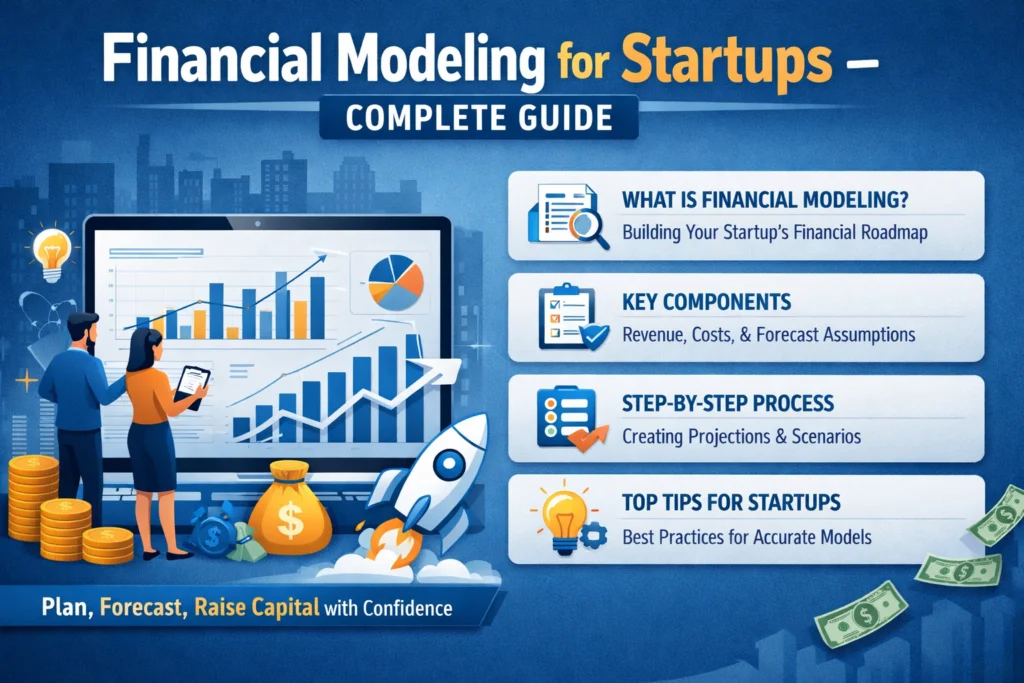
This financial modeling for startups – complete guide is designed to transform that anxiety into confidence. Whether you’re launching in Dubai Internet City, Riyadh’s King Abdullah Financial District, or Abu Dhabi’s Hub71, you’ll learn how to build a model that doesn’t just impress investors—it helps you sleep better at night.
At its core, financial modeling for startups is the art and science of translating your business vision into numbers . It’s a structured forecast that projects how your business will perform over time, typically including:
Think of it as a flight simulator for your business. Before you take off, you want to know how your plane handles turbulence, headwinds, and unexpected detours .
Irene de Gooyer-Collins, a seasoned CFO who has guided countless startups, puts it beautifully: “A financial model is a decision-making tool that connects vision with reality. Numbers tell the story of your business.”
Most founders think of financial modeling only when they’re about to raise money. But that’s like buying a life jacket only after the boat starts sinking. A robust financial model serves five critical purposes :
Should you hire that senior developer now or wait six months? Can you afford that aggressive marketing campaign? Your model answers these questions with data, not gut feeling.
From inventory to staffing, financial modeling clarifies the true cost of running your business. It reveals where efficiency gains hide and where cash leaks occur.
As de Gooyer-Collins wisely advises: “If you think you might breach a bank covenant or miss payroll, model it now, not when it’s too late.” Anticipating risks helps you build resilience before a crisis hits.
When you take other people’s money, they care deeply about how you forecast and perform. A credible model demonstrates that you’re a responsible steward of capital .
Perhaps most critically, your model gives you visibility into your runway—how long until you run out of cash. Update this weekly, not quarterly. “You want to see problems six months ahead—not six days,” de Gooyer-Collins emphasizes .
One of the first decisions in financial modeling for startups is choosing your approach. Each has its place, but one will serve you better as you scale .
What it is: Start with a big market number. “The UAE e-commerce market is $9 billion. If we capture 1%, that’s $90 million in revenue.”
When to use: Early idea validation, quick pitch decks, high-level market sizing.
The catch: It tells you nothing about execution. How exactly do you capture that 1%? Who will buy? What will it cost to acquire them?
What it is: Build from the ground up, line by line. “Each sales rep can close 3 deals per month at $5,000 each. With 5 reps, monthly revenue is $75,000.”
When to use: Operational planning, fundraising for scaling companies, day-to-day decision-making.
Why it wins: This approach creates accountability and drives execution . It tells you what it will actually take to hit your targets and shows where you’re off track if you miss.
Expert Insight: “If you’re actively scaling a business, you need a bottom-up financial model,” advises Burkland Associates, a firm that’s helped hundreds of startups build growth-ready models .
Let’s walk through the practical steps of building a model that works. I recommend starting with a 36-month monthly forecast for early-stage startups .
Your revenue forecast should be rooted in data, not hope. Start with these questions:
Pro Tip: Use a blended approach. Combine bottom-up capacity planning (“our sales team can close X deals”) with top-down market validation (“the TAM is Y, and we can realistically capture Z%”) .
For most startups, headcount is the largest expense. Map out:
Use productivity ratios to guide hiring . For example:
Beyond headcount, you’ll need to model:
Sanity Check: Few companies achieve over 50% pre-tax profit margins . If your model shows 80% margins with minimal expenses, revisit your assumptions.
This is where many founders stumble. Working capital tracks the timing of cash movements.
A profitable business can still go bankrupt if cash timing is mismanaged. Your cash flow statement is your reality check .
The future is uncertain. Smart founders prepare for multiple outcomes :
“The goal isn’t to impress—it’s to demonstrate good stewardship. Investors appreciate founders who know their limits and plan responsibly,” notes Burkland .
Here’s where this financial modeling for startups – complete guide becomes uniquely valuable for Middle East founders. Your model must reflect the realities of doing business in the UAE and Saudi Arabia .
Salaries vary dramatically across the region. Use local data from sources like Mercer’s Cost of Living Surveys to benchmark:
Factor in costs specific to your structure:
When you present your model to investors—whether regional VCs like MEVP, STV, or global firms—they’re checking for specific elements :
Even experienced founders make mistakes. Here are the most common—and how to steer clear .
The Mistake: Assuming you’ll close enterprise clients in 30 days.
The Fix: Talk to other founders. Double your estimated sales cycle length.
The Mistake: Underestimating trademark registration, data protection compliance, or licensing fees.
The Fix: Consult with a local corporate services provider early in your planning.
The Mistake: Creating a “set-and-forget” forecast.
The Fix: Make forecasting a monthly ritual. Compare actuals to projections, understand variances, and update assumptions.
The Mistake: An unbalanced balance sheet is embarrassing and erodes investor confidence .
The Fix: Use a template from a professional, or work with experts who build balanced models daily.
The Mistake: Assuming profit equals cash in the bank.
The Fix: Always model cash collection timing. You can be profitable on paper and still miss payroll if customers pay slowly.
You don’t need expensive software to start. Many successful startups begin with spreadsheets .
| Stage | Recommended Tool | Why |
|---|---|---|
| Early Stage | Excel or Google Sheets | Flexible, familiar, and free. Use clear templates. |
| Growth Stage | Finmark, Mosaic, or Fathom | Better visualization and integration with accounting software |
| Advanced | Anaplan or Adaptive Insights | Real-time scenario planning for complex operations |
Here’s something most guides won’t tell you: your first financial model will be wrong. Probably very wrong.
That’s not a failure. It’s the point.
The purpose of financial modeling isn’t to predict the future perfectly. It’s to:
“The best startup financial models are usually not ‘right’—but the differences between the projections and actual results can drive insight into the company’s potential,” explains Kruze Consulting .
When you miss a projection, don’t hide from it. Ask: What did we assume incorrectly? What does this teach us about our customers, our market, or our operations? That learning is gold.
You now have the framework to build a financial model that serves your startup—not as a compliance exercise, but as a strategic asset. Whether you’re launching your first MVP or preparing for a Series A round, the principles in this financial modeling for startups – complete guide will serve you well.
But let’s be honest: building a robust, investor-ready model takes time, expertise, and deep understanding of local market dynamics. If you’d rather focus on building your product and serving customers—and leave the spreadsheets to experts—Ghalib Consulting is here to help.
At Ghalib Consulting, we specialize in creating dynamic, investor-ready financial models tailored to the UAE and KSA markets. Our team brings:
✅ Local Market Expertise – We understand the unique costs, regulations, and opportunities in the Middle East
✅ Professional Standards – Models built with best practices used by international consulting firms
✅ Investor Credibility – Clean, structured models that communicate your story with confidence
✅ Ongoing Support – We help you update and use your model as your business grows
Don’t let spreadsheet anxiety hold your startup back.
📞 Contact Ghalib Consulting today for a free consultation. Let’s turn your vision into numbers that investors trust—and that help you build the business you’ve dreamed of.