Phone: +966-50-7024644 | Email: info@ghalibconsulting.com

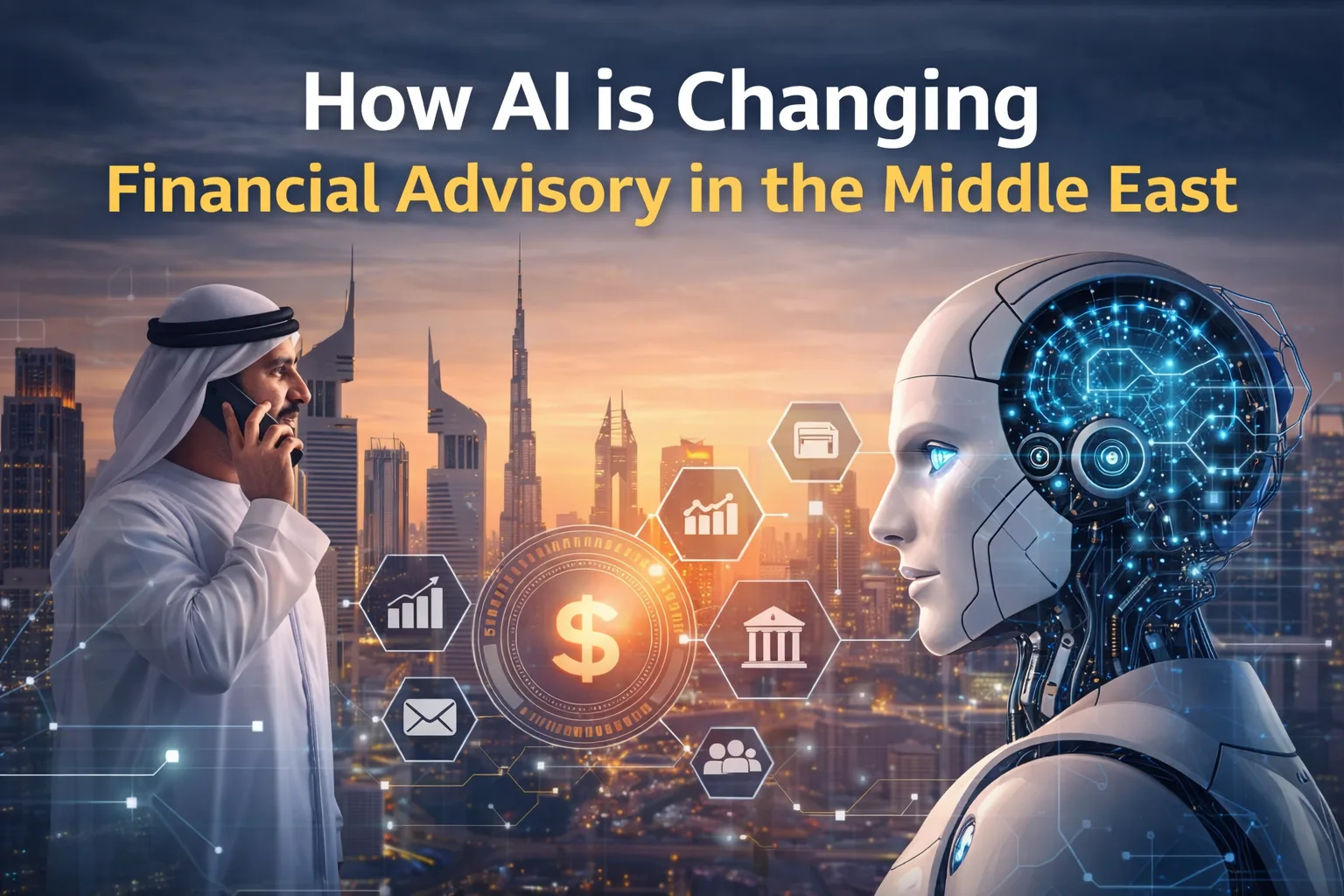

Table of Contents
How AI is Changing Financial Advisory in the Middle East
Introduction
Imagine walking into a bank in Riyadh or Dubai and receiving investment advice that has been personalized by analyzing millions of data points—your spending habits, risk tolerance, regional economic trends, and even global market movements—all in real time. This isn’t a scene from a sci-fi movie. It’s the reality of modern finance in the Gulf Cooperation Council (GCC) today.
The region is witnessing a profound transformation. Sovereign wealth funds are pouring billions into technology, regulators are racing to keep pace with innovation, and a new generation of investors expects digital-first, personalized service. At the heart of this shift lies a powerful force: how AI is changing financial advisory in the Middle East is no longer a question for the future—it is defining the present.
From automated portfolio managers to intelligent compliance systems, artificial intelligence is reshaping the advisor-client relationship, democratizing access to wealth management, and forcing traditional firms to rethink their business models.
The Middle East’s AI Revolution in Finance: By the Numbers
To understand the magnitude of this shift, consider the data. The GCC AI-driven wealth management market was valued at USD 1.1 billion in 2024, fueled by the rapid adoption of AI technologies and a surge in demand for personalized financial solutions .
This growth is underpinned by staggering regional wealth. The GCC’s assets under management reached USD 2.2 trillion in 2024, reflecting a 9% growth rate driven by Saudi Arabia and the UAE . More importantly, the investor mindset has shifted dramatically. A striking 71% of GCC investors expect wealth managers to incorporate AI into their offerings, and 13% express a high level of trust in AI-powered solutions—a figure actually higher than in North America and Europe .
| Metric | Value |
|---|---|
| GCC AI-Driven Wealth Management Market Value (2024) | USD 1.1 Billion |
| GCC Assets Under Management (2024) | USD 2.2 Trillion |
| Investors Expecting AI Integration | 71% |
| Investors Highly Trusting AI Solutions | 13% |
The global rankings confirm this leadership. The Global AI for Finance Competitiveness Index places Saudi Arabia 7th and the UAE 9th worldwide, recognizing not just their technological capability but their ability to deploy AI into operational, regulated financial systems . The UAE, in particular, is described as a “system builder” that competes on the speed of AI adoption and regulatory modernization .
From Novelty to Infrastructure: How AI is Reshaping Advisory Services
The conversation around AI in finance has matured. It is no longer about experimental chatbots or basic automation. As Himanshu Khandelwal, CEO of Asas Capital, notes, “AI is now a core operating layer in private wealth, not an experimental tool” .
1. Agentic AI and Advisor Augmentation
One of the most significant developments is the rise of “agentic AI”—systems that can autonomously execute complex workflows. In the GCC banking sector, this technology could unlock up to USD 100 billion in additional value, particularly in managing credit risk and SME lending .
Consider what this means in practice. Platforms like Galytix’s CreditX can complete up to 30 hours of manual credit analysis work in under 30 minutes . This isn’t about replacing human advisors; it’s about augmentation. By automating administrative heavy lifting—data ingestion, financial analysis, memo generation, and peer comparison—AI frees senior advisors to focus on what truly matters: judgment, strategy, and navigating complex family dynamics .
2. Personalized Wealth Management at Scale
The days of one-size-fits-all portfolio recommendations are ending. AI enables hyper-personalization. Automated investment platforms (robo-advisors) are gaining traction for their cost-effectiveness and accessibility, particularly among retail investors .
However, the market is also seeing strong growth in hybrid models that combine AI with human advisory . This reflects a sophisticated client preference: they want the efficiency and data-crunching power of machines, but they still value the empathy, context, and accountability that only a human can provide.
A panel at the recent Forbes Middle East Top Advisors & Investors Summit in Abu Dhabi captured this balance perfectly. The consensus was clear: while AI accelerates analysis and strengthens investment intelligence, human judgment remains central for high-stakes decisions . As Forbes noted, “AI can strengthen analysis and reduce blind risk, but capital decisions still require experience and accountability” .
3. Real-World Applications: From Apps to Compliance
The theoretical is rapidly becoming tangible. GFH Financial Group recently launched an AI-powered investor mobile app at the Future Investment Initiative in Riyadh . The app provides personalized investment insights and features a chatbot integrated with OpenAI for 24/7 customer support, even allowing subscriptions to investment funds through digital and crypto wallets .
On the regulatory front, AI is becoming indispensable for compliance. In Egypt, the Financial Regulatory Authority (FRA) has already issued guidelines for AI-based portfolio management, recognizing that embracing technology is essential for progress . Across the GCC, firms are using AI for transaction monitoring, suspicious activity detection, and regulatory reporting to meet stringent requirements .
The Investment Case: $33.79 Billion and Counting
The infrastructure supporting this AI revolution is massive. Middle East data-center colocation markets are targeting USD 33.79 billion in cumulative investments from 2025 to 2030, with the UAE and Saudi Arabia leading the build-out across Dubai and Riyadh hubs . Gulf sovereign wealth funds continue to sustain AI and private market investments despite global valuation concerns, providing a stable capital base that other regions may lack.
However, a note of caution is warranted. Demis Hassabis, CEO of Google DeepMind, recently warned that AI investment exhibits “bubble-like” characteristics, with company valuations increasingly detached from commercial realities . For financial advisory firms in the Middle East, this suggests a need for disciplined execution. A market correction could compress funding for early-stage fintech startups, favoring established players with strong balance sheets and clear path-to-profitability metrics.
Navigating the Challenges: Governance, Data, and Skills
Despite the optimism, significant hurdles remain. A regional survey by Deloitte reveals a critical gap: while 93% of respondents expect AI to have a significant long-term impact on their organizations, only 9% have begun scaling solutions, and just 10% have enterprise-wide AI strategies and governance frameworks in place .
Key Challenges:
- Data Privacy Concerns: With regulations like GDPR influencing local laws, 60% of wealth management firms report concerns about data security, which could hinder AI adoption .
- High Initial Investment Costs: Firms typically need to allocate USD 600,000 to USD 1.2 million for technology integration and staff training, a burden that can disadvantage smaller firms .
- The Execution Gap: Many organizations are still navigating how to move from pilots to scalable impact, with 63% remaining in pre-implementation stages .
The path forward requires stronger governance, clearer operating models, and structured roadmaps . As Deloitte’s Muhammad Bahemia puts it, “Leaders clearly recognize the technology’s potential, but many are now confronting the harder question of how to scale it responsibly” .
What This Means for You: The Client Perspective
If you are a business owner, an investor, or a family office in the UAE or Saudi Arabia, how AI is changing financial advisory in the Middle East has direct implications for your financial future.
For High-Net-Worth Individuals (HNWIs): You can now expect institutional-grade governance and transparency delivered through relationship-led execution. The bar has been raised. Real-time digital reporting is non-negotiable, and portfolios are increasingly built around resilience, selective growth, and regional conviction .
For the Mass Affluent and Retail Investors: AI is democratizing access. The underserved mass affluent segment presents a key opportunity for digital wealth managers to expand their reach with low-cost, user-friendly platforms . You no longer need millions to access sophisticated investment strategies.
For SMEs: AI-powered credit assessment tools are opening up lending opportunities that were previously inaccessible due to fragmented data and manual processes .
Conclusion: The Future is Hybrid
So, where does this leave us? The evidence is overwhelming: how AI is changing financial advisory in the Middle East is a story of evolution, not replacement. The future belongs to hybrid models—where AI handles the heavy lifting of data analysis, compliance, and portfolio optimization, while human advisors provide the wisdom, context, and trusted relationships that machines cannot replicate.
The region is uniquely positioned to lead this transformation. With government backing, substantial capital reserves, and a young, tech-savvy population, the GCC can navigate the challenges of governance and scaling to build a financial advisory ecosystem that is both technologically advanced and deeply human.
The question is no longer if you should embrace AI in your financial planning, but how.
How Ghalib Consulting Can Help You Navigate the AI Era
At Ghalib Consulting, we understand that navigating this new landscape can feel overwhelming. With over a decade of experience serving clients across the UAE, Saudi Arabia, and Pakistan, we combine deep regional expertise with a forward-looking approach to financial advisory.
Whether you need assistance with:
- Financial Planning & Analysis that integrates AI-driven insights,
- Feasibility Studies that leverage predictive analytics,
- Business Valuation using advanced modeling techniques, or
- Tax Planning that adapts to regulatory changes,
our team of experienced professionals is here to guide you.
Don’t let your financial strategy fall behind. The AI revolution in finance is happening now. Let’s ensure you’re not just keeping pace, but leading.
👉 Contact Ghalib Consulting today for a free consultation. Let’s discuss how we can help you make smarter, data-driven financial decisions.