Phone: +966-50-7024644 | Email: info@ghalibconsulting.com

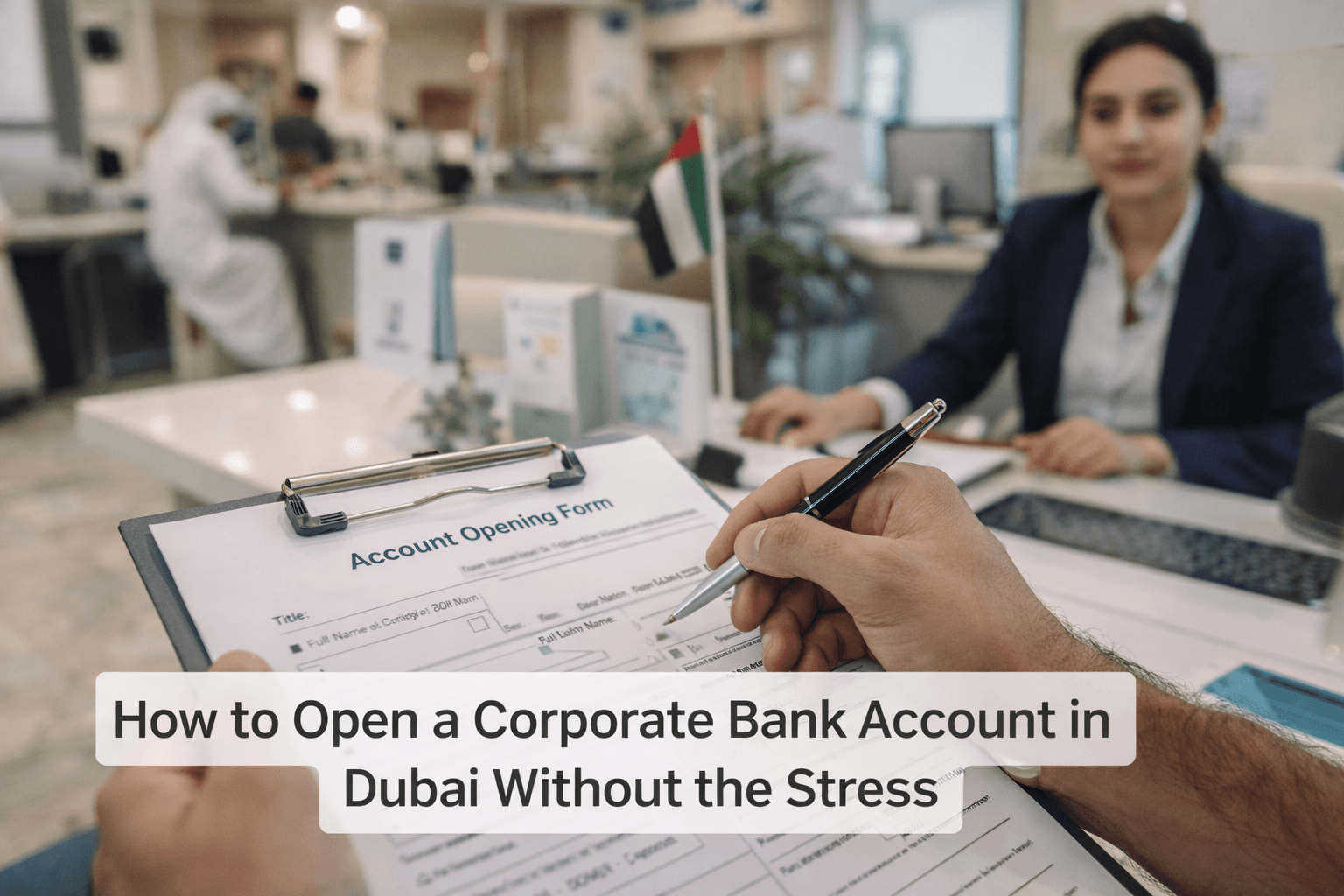

Table of Contents
How to Open a Corporate Bank Account in Dubai Without the Stress
Introduction: The Account That Almost Broke Me
I remember sitting across from a relationship manager at a Dubai bank, my carefully organized folder of documents sitting between us like a final exam I hadn’t studied for. My company was already licensed. My business plan was solid. Yet something in the way she scanned my trade license told me I was about to hear the words that haunt every entrepreneur in the UAE: “We need additional documentation.”
Three weeks later, after four follow-up emails and a second in-person visit, my corporate bank account was finally approved. I celebrated like I’d won a contract with a Fortune 500 company. And here’s the strange part—I was one of the lucky ones.
If you’re reading this because you’re about to open a corporate bank account in Dubai, take a breath. The process has changed. Banks aren’t trying to be difficult; they’re trying to be safe. And once you understand why they ask what they ask, the stress dissolves into strategy .
Why Corporate Banking in Dubai Feels Like an Obstacle Course (And Why It’s Actually Protection)
Let’s reframe the narrative.
Dubai didn’t become the Middle East’s premier financial hub by handing out accounts like free samples at a supermarket. Every corporate bank account opened in the UAE sits on a foundation of Federal Decree-Law No. 14 of 2018, which governs the Central Bank and regulates financial institutions with extraordinary rigor .
When a bank asks for your shareholders’ passport copies and proof of address, they’re not being nosy. They’re complying with a risk-based approach mandated by UAE law—one that requires financial institutions to identify, assess, and monitor every customer who enters their system .
Here’s what this means for you: Transparency is your shortcut.
The entrepreneurs who struggle aren’t those with complex businesses. They’re the ones who try to make their business sound simpler than it is. Banks have seen every structure, every ownership model, and every transaction pattern. Your job isn’t to impress them. Your job is to be clear .
The Unspoken Truth: Banks Don’t Reject Companies—They Reject Uncertainty
Every declined application tells the same story: the bank couldn’t answer one of five critical questions .
Question 1: Who Actually Owns This Company?
This sounds straightforward, but you’d be surprised how many applications arrive with opaque ownership structures. If your company has multiple holding entities, shareholders in different jurisdictions, or nominee arrangements, you need to chart it out.
Pro tip: Create a visual ownership diagram before you approach any bank. Include percentages. If the Ultimate Beneficial Owner (UBO) holds shares through a trust or offshore entity, disclose it immediately. Banks will discover it anyway. Discovery during due diligence creates delays; disclosure during application builds trust .
Question 2: Is This Business Real?
A trade license proves you’re registered. It doesn’t prove you’re operating.
Banks want to see economic substance—actual evidence that your company is doing what its license says it does . This might include:
- Supplier contracts or letters of intent
- Client invoices or service agreements
- Office tenancy contracts (Ejari or free zone lease)
- Website, LinkedIn presence, or professional listings
Real talk: Free zone companies without physical offices face heightened scrutiny. If you’re operating from a flexi-desk, be prepared to explain how your business functions without a dedicated workspace. It’s possible—thousands of Dubai businesses do it—but you need a coherent narrative .
Question 3: Where Does Your Money Come From?
This is the question that catches most entrepreneurs off guard.
You’ve saved AED 100,000 from five years of freelance work in Europe. You’ve received a family gift for your startup capital. You’ve sold cryptocurrency holdings to fund your UAE expansion. All of these are legitimate sources of funds. But if you don’t document them, banks cannot verify them .
What to prepare:
- Six months of personal bank statements (home country or UAE)
- Sale agreements for assets liquidated
- Gift deeds or family declarations (notarized if possible)
- Corporate dividend certificates from previous businesses
Unsolicited advice: Don’t transfer funds to your UAE company before opening the account. Banks prefer to see the money move through their systems as part of the onboarding process.
Question 4: What Does Your Business Actually Do?
Vague descriptions trigger compliance reviews. “General trading” is a red flag. “Import and distribution of Italian ceramic tiles to UAE construction companies” is a banking relationship.
Your business activity code matters. Some activities—cryptocurrency, certain digital services, money exchange, precious metals—are automatically classified as higher risk. This doesn’t mean you can’t bank. It means you need to choose a bank with appropriate risk appetite .
Question 5: Does Your Documentation Tell One Story?
Here’s where applications fail quietly. Your trade license says “Ahmed & Partners LLC.” Your Memorandum of Association spells it “Ahmed and Partners LLC.” Your shareholder’s passport shows “Ahmed Al Mansouri” but your application lists “Ahmed Al-Mansouri.”
These inconsistencies trigger manual reviews. And manual reviews add days—sometimes weeks—to your timeline .
The fix: Before submitting anything, place all your documents side by side. Verify that every name, date, and number matches exactly. If your home country documents are not in Arabic or English, invest in certified legal translations. This is not an area to cut costs .
The Strategy: Match Your Business to the Right Banking Channel
Not all corporate bank accounts are created equal. And in 2026, you have more options than ever before.
Option A: Traditional UAE Banks
Best for: Mainland companies, established trading businesses, entities requiring credit facilities or trade finance
Typical timeline: 2–6 weeks
Minimum balance: AED 25,000–100,000+
The landscape: Emirates NBD, ADCB, Mashreq, Dubai Islamic Bank, and RAKBANK remain the primary players. These institutions offer comprehensive services but apply the strictest compliance filters .
Insider note: Some banks have dedicated free zone onboarding teams. If you’re incorporated in DMCC, DIFC, or ADGM, research which banks maintain physical branches or relationship managers within your free zone. This shortcut actually works .
Option B: Digital Banks and EMIs (Electronic Money Institutions)
Best for: Non-resident founders, startups, e-commerce businesses, companies with complex ownership structures
Typical timeline: 4–15 business days
Minimum balance: Often zero or nominal
The game-changers: Providers like 3S Money, Fyorin, Moneybase, and UAE-based platforms like Yuze and Zand are reshaping business banking .
What makes them different? These institutions were built for cross-border, digital-first businesses. They’re more tolerant of non-resident directors and non-traditional revenue models. They won’t offer you a AED 5 million credit line, but they will open your account while you’re still sitting in London or Berlin .
Strategic play: Many international entrepreneurs open an EMI account first, establish transaction history, and later transition to a traditional UAE bank. This phased approach reduces pressure and builds banking credibility .
The Document Stack: What You Actually Need (And What You Can Leave Behind)
Every guide lists documents. This one tells you what banks actually examine.
Non-Negotiable Essentials
The “Approval Accelerators”
These documents aren’t always mandatory, but including them signals professionalism and preparedness:
- Business plan (1–2 pages is sufficient) covering your target market, revenue model, and projected transaction volumes
- CVs of directors and shareholders, particularly highlighting relevant industry experience
- First contracts or invoices showing active or imminent trading
- Existing bank reference letters from your personal or previous corporate bank
Hard truth: If you cannot produce any evidence of anticipated business activity, you are asking the bank to trust you without data. Banks don’t do trust. They do verification.
The Process Timeline: What Happens After You Submit
Understanding the stages of approval reduces anxiety during the waiting period.
Stage 1: Preliminary Review (Days 1–3)
The bank confirms receipt and checks for obvious omissions. Missing Emirates ID? No tenancy contract? Your file goes on hold immediately.
Stage 2: KYC and Due Diligence (Days 4–14)
This is the black box. The bank verifies identities, screens against sanctions lists, and assesses risk based on your ownership, industry, and anticipated transaction patterns .
Stage 3: Relationship Manager Review (Days 5–20)
A human being reads your file. If your documentation is complete and your story is coherent, this stage moves quickly. If questions arise, you’ll receive a call or email.
Stage 4: Compliance Sign-Off (Varies)
For standard risk profiles, this is administrative. For medium or high-risk cases, compliance committees review applications weekly. Missing a cutoff can add 5–7 days .
Stage 5: Account Activation
You receive your IBAN, online banking credentials, and—if applicable—chequebook and debit cards.
The Non-Resident Reality: Harder, But Far From Impossible
Here’s the question I receive most frequently: “Can I open a corporate bank account in Dubai if I don’t live here?”
Non-resident founders face enhanced due diligence for one simple reason: banks cannot easily verify your identity or business activities in person. Everything must be documented, attested, and often apostilled .
Strategies that work:
- Incorporate in a free zone with strong banking relationships. DMCC, IFZA, and Meydan have reputational capital with UAE banks. Your free zone certificate carries weight .
- Consider a board resolution authorizing a UAE-based representative to act on the company’s behalf. This doesn’t require transferring ownership—just appointing an authorized signatory who can attend meetings physically .
- Start with an EMI. Seriously. Several of my contacts opened with 3S Money or Fyorin within one week, built six months of transaction history, and then successfully migrated to Emirates NBD. The EMI statements became their proof of business activity .
Red Flags and Green Lights: What Banks Actually See
Let me translate banking language into human language.
When the bank asks: “What is your expected monthly transaction volume?”
They mean: “Will your activity level cover our account maintenance costs, and does it align with your declared business size?”
When the bank asks: “Who are your major suppliers and customers?”
They mean: “Are you moving money to or from high-risk jurisdictions or unregulated entities?”
When the bank asks: “Do you have a physical office?”
They mean: “Can we verify that you’re conducting genuine economic activity in the UAE?”
Green lights that accelerate approval:
- All shareholders and directors can provide local address proof (even if non-resident, a registered office address helps)
- Your business activity appears on the bank’s list of preferred sectors
- You hold professional certifications or track record in your industry
- Your initial deposit is ready and sourced from verifiable channels
Red flags that trigger enhanced scrutiny:
- Cryptocurrency or blockchain business models (some banks outright decline; others require extensive compliance reviews)
- Ownership through high-risk jurisdictions as defined by FATF
- Cash-intensive businesses without clear transaction trails
- Multiple license amendments in the first year of operation
The Human Element: Why Relationship Managers Matter
Here’s something rarely discussed in corporate banking guides: your relationship manager is not your enemy.
These professionals are measured on portfolio quality. They want to onboard businesses that won’t trigger compliance alerts, generate fee income, and maintain clean transaction patterns. If you appear risky, they’re not rejecting you personally—they’re protecting their book .
How to build rapport:
- Be concise. Provide complete information upfront rather than dribbling documents over two weeks.
- Acknowledge the compliance burden. A simple “I understand you need to verify these details thoroughly” signals that you’re not going to argue every request.
- Follow up professionally. One email per week is appropriate. Daily calls are counterproductive.
The Digital Shift: 2026’s Most Underestimated Advantage
Two developments have fundamentally changed corporate banking in the UAE this year.
First: The Central Bank’s e-KYC initiative is enabling faster digital verification for licensed financial institutions. This doesn’t reduce compliance standards—but it does reduce manual processing time .
Second: Partnerships between traditional banks and fintech platforms are creating hybrid onboarding experiences. The alliance between Yuze and Zand, for example, offers AI-enabled business banking with significantly faster account opening for eligible SMEs .
What this means for you: The “wait six weeks and pray” era is ending. If you’re still experiencing prolonged delays with straightforward documentation, you may be approaching the wrong institution.
Your Pre-Submission Checklist
Before you email that application, run this final verification:
☐ Trade license issued and valid (minimum 6 months remaining)
☐ MOA/AOA notarized and—if foreign—attested through UAE embassy and Ministry of Foreign Affairs
☐ All shareholder passports scanned in color, no cropping
☐ Emirates ID for all UAE residents (both sides)
☐ Proof of address documents dated within 90 days
☐ Office tenancy contract registered (Ejari for mainland, valid lease for free zone)
☐ Business plan outlining products/services, target clients, and projected monthly transactions
☐ Source of funds documentation for initial deposit
☐ CVs for key principals demonstrating industry experience
One more thing: Have a UAE mobile number for at least one authorized signatory. Banks use SMS verification throughout the onboarding process, and international numbers occasionally experience delays .
Conclusion: The Account Is Just the Beginning
Opening your corporate bank account in Dubai feels like the finish line. In reality, it’s the starting line.
That account will process your first client payment, facilitate your first employee salary transfer, and eventually support your first trade finance facility. It’s not a transaction—it’s a banking relationship.
The entrepreneurs who navigate this process successfully aren’t those with the simplest business models. They’re the ones who approach banking with the same seriousness they brought to their company formation. They prepare. They disclose. They follow up.
And when they finally receive that “account activated” notification, they don’t celebrate because the stress is over. They celebrate because they’ve earned the trust of an institution whose job is to trust carefully.
How Ghalib Consulting Eliminates the Stress
At Ghalib Consulting, we’ve guided hundreds of businesses through the corporate bank account opening process in the UAE and KSA. We don’t just hand you a document checklist and wish you luck.
We help you:
- Assess which banks are genuinely open to your business profile
- Prepare a compliant, complete application package the first time
- Articulate your business model clearly to relationship managers
- Navigate enhanced due diligence requests without panic
- Establish ongoing banking relationships that support your growth
You’ve already done the hard part—you built a business. Let us handle the banking.
📧 Email us: ghalib@ghalibconsulting.com