Phone: +966-50-7024644 | Email: info@ghalibconsulting.com

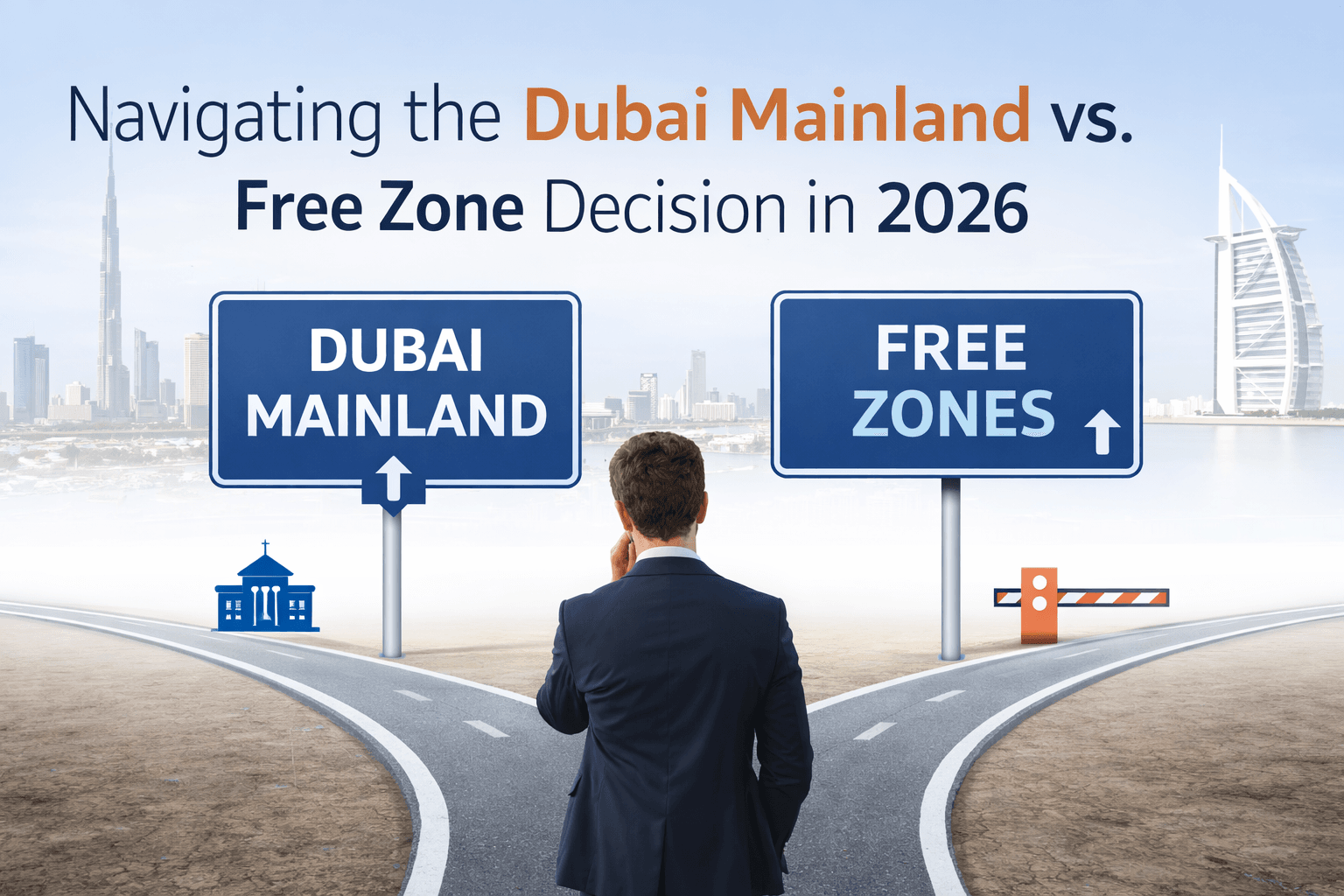

Table of Contents
Navigating the Dubai Mainland vs. Free Zone Decision in 2026: The Entrepreneur’s Crossroads
Introduction: The Question That Keeps Founders Awake
I still remember the anxiety.
It was 2:00 AM in a hotel room overlooking Sheikh Zayed Road. My laptop screen glowed with 37 browser tabs—some promising “100% ownership,” others warning about “hidden distribution requirements.” The Google results blurred together. Every consultant said something different.
Dubai Mainland vs. Free Zone decision. Three words. One massive consequence.
Seven years later, I’ve helped dozens of founders navigate this exact crossroads. And here’s the truth: the rules have changed completely in 2026. What worked for your friend who set up in 2022? Probably irrelevant now. The old playbook? Burn it.
This isn’t a generic comparison table ripped from a consultancy website. This is what I wish someone had told me at 2:00 AM.
The 2026 Reality: The Blurring Line
Here’s the headline nobody is shouting loud enough: The wall between Mainland and Free Zone is crumbling.
In March 2025, Dubai Executive Council issued Decision No. 11/2025 . If you haven’t read it, don’t worry—most people haven’t. But its implications are seismic.
Free Zone companies can now operate directly on the Dubai Mainland. No local distributor. No mainland partner. Just a license from the Department of Economy and Tourism .
Wait—does this mean the Free Zone vs. Mainland debate is dead?
Absolutely not. It just got more nuanced.
You’re no longer choosing between “prison” and “freedom.” You’re choosing between two different ecosystems, each with its own tax mathematics, compliance burden, and strategic ceiling.
The Silent Trap: What the Brochures Don’t Tell You
Every Free Zone website shows happy entrepreneurs holding golden visas. Every Mainland consultant promises “unlimited market access.” Both are telling the truth. Neither is telling you the whole truth.
The Free Zone Trap: “But We Have a Dubai Office…”
I watched a SaaS founder learn this the hard way.
He set up in a popular Free Zone. Paid for the flexi-desk. Got his license in four days. Started invoicing UAE clients. Everything felt perfect.
Then his largest Dubai client asked him to come onsite for a security audit. The facility manager stopped him at the gate.
“Your company isn’t in our approved vendor system. You’re not registered with DET.”
His Free Zone license, issued just 200 meters from that gate, meant nothing to the Dubai government entity running the facility.
The 2026 reality: Yes, you can trade on the Mainland with a Free Zone license. But “can trade” and “can bid for government contracts, register in supplier portals, or open certain types of bank accounts” are different sentences .
The Mainland Trap: “It’s Just 9%…”
Another founder. Consulting business. Profitable first year—AED 420,000.
His mainland consultant said: “Corporate tax is only 9% above AED 375,000. You’ll pay peanuts.”
What they didn’t emphasize: That’s 9% on every dirham above the threshold, not the total. His tax bill? Approximately AED 4,050. Not devastating. But here’s what gnaws at him:
His friend in a Free Zone, earning AED 500,000 from international clients? Zero percent.
The 2026 reality: If your revenue is primarily outside the UAE, the Free Zone offers tax mathematics that Mainland simply cannot match. Qualifying Free Zone Person (QFZP) status isn’t marketing jargon—it’s AED 50,000+ annual savings for high-earning consultants .
The Three Questions That Actually Matter
Forget the 47-point comparison checklist. Your decision distills to three questions.
Question 1: Who Is Your Real Customer?
Scenario A: Your customers are in the UAE. They’re Dubai residents. They walk into stores. They expect VAT invoices from a locally registered entity with a physical presence they can visit if something goes wrong.
Scenario B: Your customers are in London, Singapore, Riyadh, and New York. Your “office” is Zoom. Your product lives in the cloud. You’re in Dubai for the lifestyle, the tax efficiency, and the time zone.
→ Free Zone was designed for you.
I know—this sounds obvious. Yet I’ve met e-commerce founders in Free Zones paying 5% import duties on goods they immediately sell to Dubai residents, when a mainland license would have eliminated that cost entirely. And I’ve met consultants on mainland licenses paying 9% corporate tax on income from Germany that could have been zero percent in a Free Zone.
Geography of revenue, not geography of residence, determines your optimal structure.
Question 2: What Is Your Profit Trajectory?
Let me share a table I wish existed when I started.
| Profit Level (AED) | Mainland Tax Impact | Free Zone (QFZP) Tax Impact | Verdict |
|---|---|---|---|
| Below 375,000 | 0% | 0% | Tie – Choose based on market access |
| 375,000 – 500,000 | 9% on profit above 375k | 0% if income qualifies | Free Zone wins for int’l businesses |
| 500,000 – 1M | ~AED 11k–56k tax | 0% if compliant | Free Zone significantly wins |
| Above 1M | 9% on everything above 375k | 0% on qualifying income | Free Zone wins for export-oriented |
| Mixed UAE/Int’l | Full 9% above threshold | 0% on int’l, 9% on local >5% of revenue | Hybrid structures emerge |
Source: Compiled from UAE Corporate Tax Law and QFZP conditions
The 2026 insight: Mainland is a toll road with a flat fee once you hit 375k. Free Zone is a toll road that waives the fee entirely if you take the “export” exit.
Question 3: Can You Prove “Substance”?
This is the 2026 question that catches people sleeping.
The 0% corporate tax rate in Free Zones isn’t automatic. It requires Qualifying Free Zone Person (QFZP) status . Translation:
- You need adequate assets
- You need adequate income
- You need adequate employees
- You need to pass the economic substance test
The shell company era is over.
I watched a two-person trading company lose their 0% status because they couldn’t demonstrate that their “office”—a hot desk they visited twice monthly—constituted adequate substance for AED 3 million in annual trade.
Mainland doesn’t ask this question. You pay 9% above threshold. Done. No substance theater.
The 2026 Playbook: Three Archetypes
After walking through this with dozens of founders, patterns emerge. Here’s your cheat sheet.
Archetype A: “The Local Player”
Restaurant owner. Retailer. Construction contractor. Education provider.
Verdict: Mainland.
You cannot escape the physicality of your business. Your customers expect you to exist in their world. The new construction regulations effective January 2026 require contractor registration with Dubai Municipality—something only Mainland-licensed entities can easily navigate . Don’t fight gravity.
Archetype B: “The Global Expert”
Consultant serving international clients. SaaS founder. Creative agency with overseas brands.
Verdict: Free Zone.
Specifically, look at cost-competitive zones like UAQFTZ or Ras Al Khaimah, not just the glamorous Dubai names. UAQFTZ offers packages starting under AED 5,000 with full compliance support for the 2026 e-invoicing requirements . Your clients never ask where your office is. Don’t pay for real estate you don’t need.
Archetype C: “The Hybrid”
Trader who imports goods, stores them in the UAE, and sells partly locally, partly internationally.
Verdict: This is complicated. Read carefully.
You have three options, each with trade-offs:
- Pure Free Zone: Store goods in a Designated Zone. Sell internationally tax-free. Sell locally through a registered distributor or pay 5% customs upon market entry.
- Pure Mainland: Pay customs upfront. Pay 9% corporate tax on all profit above 375k. But sell to anyone, anywhere, without intermediaries.
- Dual Structure: Free Zone for international trade + Mainland branch for local sales. Higher setup cost. Maximum tax efficiency.
Most scaling traders eventually choose Option 3. It’s the difference between minimizing taxes and maximizing addressable market.
The Hidden Variable: Banking
Nobody talks about this enough.
Free Zone companies—especially newer, smaller zones—struggle with bank account opening.
I’ve seen founders with perfect documentation, clean business plans, and six-figure revenue projections wait four months for a bank account. Meanwhile, their Mainland counterparts open accounts in two weeks.
Why? Compliance departments understand Mainland licenses. They understand DET-regulated entities. Free Zones? There are 40+ of them. Some have excellent reputations (DIFC, ADGM, JAFZA). Others… less so.
2026 reality: If you choose an obscure Free Zone to save AED 3,000 on setup, you might spend AED 30,000 in lost time waiting for banking approvals. Factor this into your cost calculation.
Personal Story: The Founder Who Switched Twice
Ali is a client I met in 2023.
Attempt 1: Free Zone. He was exporting AI consulting to the US. Perfect fit. Zero tax. Life was good.
Attempt 2: Mainland. He won a contract with a Dubai government entity. His Free Zone license couldn’t get him approved in their vendor portal. He panic-transitioned to Mainland, paid the 9% tax, but kept the client.
Attempt 3: Free Zone (again). His government contract ended. He was back to international clients. Why pay 9%? He maintains his Mainland license as a dormant entity—expensive, but keeps the door open.
Ali’s lesson: Your business structure isn’t a marriage. It’s a lease. It should change as your revenue geography changes.
Your 2026 Decision Framework
Stop reading. Open a note. Answer these five questions honestly.
- Where will your first 10 customers be located? (Be specific: Dubai, Abu Dhabi, KSA, Europe, US?)
- What is your realistic Year 1 profit? (Not your dream. Your reality.)
- Do you need physical space for customers to visit you?
- Will you ever bid for government or semi-government contracts?
- Can you clearly demonstrate “substance” if audited?
Your answers will not lie to you. They will point you toward Mainland or Free Zone with surprising clarity.
Beyond Setup: The Compliance Marathon
Here’s the part that kept me awake at 2:00 AM but nobody warns you about:
Getting the license is the easy day.
The hard days are:
- Month 4, when your first VAT return is due
- Month 10, when you realize your “flexi-desk” doesn’t qualify for the visa quota you need
- Month 16, when the Federal Tax Authority asks for evidence of your qualifying income
- Month 22, when you want to expand into Saudi Arabia and discover your Free Zone license creates unexpected complications
This is where Ghalib Consulting enters the story.
Not as the “we’ll file your paperwork” vendor. As the strategic partner who ensures your 2026 structure still makes sense in 2027, 2028, and 2029.
We don’t just ask: “Mainland or Free Zone?”
We ask:
- “What happens when your revenue hits AED 1 million?”
- “How will you prove substance to the tax authorities?”
- “Is your structure optimized for the KSA expansion you’re planning next year?”
- “Does your banking strategy match your licensing choice?”
The Final Word
The Dubai Mainland vs. Free Zone decision in 2026 isn’t about 100% ownership anymore. Everyone gets that. It’s not about “trading anywhere”—everyone can do that now, with caveats.
It’s about matching your corporate structure to your actual revenue geography, profit trajectory, and risk tolerance.
The wrong choice costs you:
- ✅ Tax efficiency
- ✅ Market access
- ✅ Banking speed
- ✅ Founder sanity
The right choice? It fades into the background, quietly enabling your growth without demanding your attention.
Let’s Map Your 2026 Structure Together
You’ve read the research. You’ve seen the frameworks. Now you need a partner who has walked this path—not just read about it.
At Ghalib Consulting, we combine financial planning expertise with on-the-ground UAE and KSA business setup experience. We don’t sell licenses. We solve structural problems.
[📅 Book Your 30-Minute Structure Audit]
Bring your business plan. Bring your revenue projections. Bring your questions about QFZP status, substance requirements, and cross-border expansion.
We’ll give you clarity—not a sales pitch.