Phone: +966-50-7024644 | Email: info@ghalibconsulting.com



Table of Contents
The 3-Statement Model: The Heartbeat of Every Sound Financial Decision in UAE & KSA Business
Picture this: You’re sitting across from a potential investor in a sleek Dubai Marina boardroom. They’ve listened to your pitch about expanding into Saudi Arabia’s booming market. Now they ask the crucial question: “Show me your financial story—not just your profits, but your entire financial health.”
If you reach for just your profit statement, you’ve already lost. But if you present a synchronized 3-Statement Model—showing how your Income Statement, Balance Sheet, and Cash Flow Statement dance together—you’re speaking the universal language of trust.
For businesses navigating the dynamic landscapes of the UAE and Saudi Arabia, the 3-statement model isn’t just an accounting exercise. It’s the financial compass that guides every strategic decision, from Riyadh’s Vision 2030 megaprojects to Dubai’s entrepreneurial startups.
What Exactly Is the 3-Statement Model?
At its core, the 3-statement model is a unified financial framework that connects three essential reports:
- Income Statement (Profit & Loss): What we earned and spent
- Balance Sheet (Statement of Financial Position): What we own and owe
- Cash Flow Statement: Where our cash actually moved
Think of it as a medical check-up for your business. The Income Statement is your vital signs, the Balance Sheet is your anatomy scan, and the Cash Flow Statement is your circulation system. You need all three to get an accurate diagnosis.
Why This Matters More in the Middle East Context
During my years at PwC and now through Ghalib Consulting, I’ve seen firsthand how regional businesses often focus disproportionately on profitability while neglecting cash flow—a dangerous oversight in markets experiencing rapid growth and transformation.
A UAE retail client once celebrated record profits on paper while nearly defaulting on supplier payments. Their profits were real, but their cash was trapped in inventory—a disconnect only revealed through a proper 3-statement analysis.
The Three Pillars: How They Work Together
1. The Income Statement: The Performance Tracker
This is where most business owners naturally look. Did we make money this quarter? For Saudi businesses navigating new VAT regulations or UAE companies adjusting to corporate tax, this statement answers the surface-level question.
Key Insight: In the GCC context, remember that “revenue recognition” can be tricky—especially for construction companies working on Saudi giga-projects with milestone payments or Dubai real estate developers with off-plan sales.
2. The Balance Sheet: The Financial Snapshot
This is your business’s financial position at a specific moment. What’s often missed is how the UAE and KSA’s asset-heavy business models (real estate, infrastructure, manufacturing) make this statement particularly crucial.
| Typical Strong Indicators | Red Flags in GCC Context |
|---|---|
| Healthy cash reserves | High receivables > 90 days |
| Manageable debt ratios | Inventory growing faster than sales |
| Strong equity position | Over-reliance on short-term financing |
3. The Cash Flow Statement: The Reality Check
This is where the truth emerges. I’ve advised family businesses in Riyadh showing profits for years while their cash position quietly deteriorated. The cash flow statement separates accounting reality from economic reality—particularly important in markets where payment cycles can be extended.
The Magic Happens in the Connections
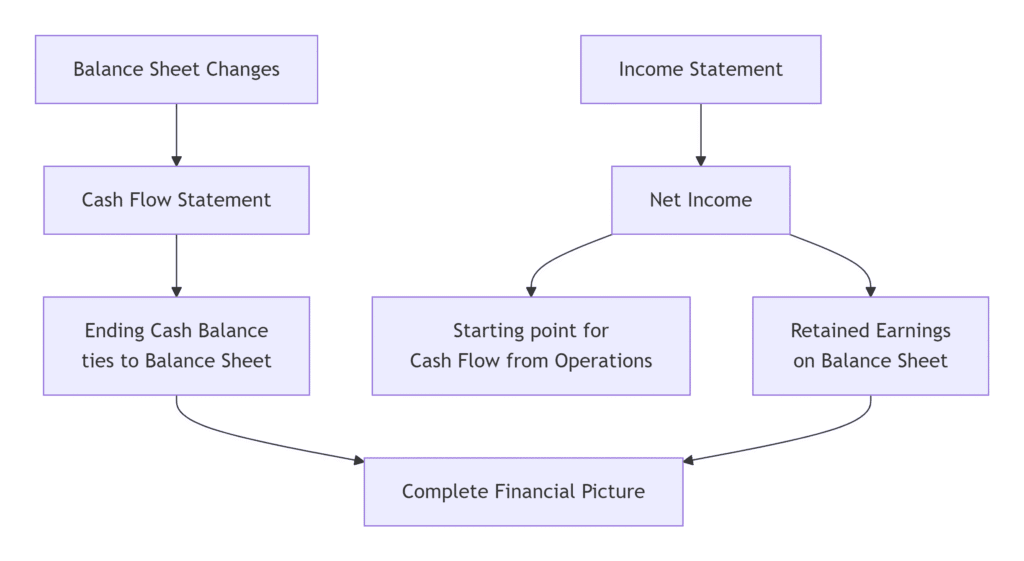
Here’s what most articles don’t tell you: The 3-statement model isn’t valuable because of the three statements individually, but because of how they interconnect:
Example Connection:
When a Dubai tech startup secures a loan (Balance Sheet: liabilities increase), it pays interest (Income Statement: expense increases), and receives cash (Cash Flow Statement: financing cash inflow). One transaction, three impacts.
The “Aha!” Moments This Model Reveals:
- Profit ≠ Cash: You can be profitable but bankrupt if customers don’t pay
- Growth Requires Fuel: Expanding in KSA requires cash for inventory, payroll, and compliance—not just profits
- Debt Servicing Capacity: Can you actually make loan payments from operations?
Practical Applications for UAE & KSA Businesses
For Saudi Companies Eyeing Expansion:
When considering a new factory in NEOM or Riyadh, the 3-statement model helps answer:
- How will financing affect our balance sheet?
- When will the project become cash flow positive?
- What’s the true ROI considering all three statements?
For UAE SMEs Seeking Investment:
Emirati startups seeking venture capital need to demonstrate not just traction (Income Statement) but also:
- Burn rate and runway (Cash Flow)
- Capital efficiency (Balance Sheet ratios)
- Path to profitability with positive cash flow
Common Pitfalls in the GCC Region
Through our work at Ghalib Consulting, we’ve identified consistent patterns:
The Family Business Trap: Many established family businesses in the region maintain separate mental accounts for different aspects of the business. The 3-statement model forces integration and reveals hidden inefficiencies.
The Rapid Growth Mirage: Especially in Dubai’s startup scene, companies often celebrate top-line growth while ignoring deteriorating working capital ratios—a disconnect clearly visible only in the integrated model.
The Compliance Blind Spot: With new corporate tax regulations in the UAE and evolving VAT rules in KSA, tax liabilities don’t just hit the Income Statement—they affect cash planning and balance sheet health.
Building Your Own 3-Statement Model: A Practical Start
You don’t need expensive software to begin. Start with Excel and these steps:
- Historical Foundation: Input 2-3 years of actual financials
- Revenue Drivers: Identify what actually drives sales in your market
- Working Capital Assumptions: Model realistic payment terms for your industry
- Capital Expenditure Planning: Align with your actual expansion plans
- Financing Strategy: Model debt repayments and equity injections
Pro Tip for GCC Businesses: Always model in both your functional currency AND USD, given the region’s dollar-pegged currencies and international trade flows.
The Strategic Advantage in Today’s Market
In uncertain economic times—whether global inflation or regional market shifts—the 3-statement model provides what leaders truly need: clarity.
A well-maintained model answers critical questions:
- Can we withstand a 3-month payment delay from our largest Saudi client?
- What’s our true capacity to bid on that Abu Dhabi government tender?
- How will rising interest rates affect our Dubai real estate portfolio?
Beyond the Numbers: The Human Element
Here’s my personal conviction after 17 years in regional finance: The 3-statement model is ultimately about storytelling. It tells the complete story of where your business has been, where it stands today, and—most importantly—where it can go tomorrow.
When I sit with business owners in Al Khobar or Dubai, we’re not just connecting Excel cells. We’re connecting ambitions to realities, growth plans to funding capacities, and visions to executable strategies.
Visualizing the Connections: How the 3 Statements Interact
Conclusion: Your Financial Compass in Dynamic Markets
The 3-statement model isn’t merely an accounting requirement or a financial modeling technique. For businesses operating in the vibrant, fast-paced economies of the UAE and Saudi Arabia, it’s the foundational tool that transforms data into insight, and insight into strategic advantage.
Whether you’re a family business in Dammam planning succession, a tech startup in Dubai seeking Series A funding, or a multinational evaluating Saudi market entry, this integrated view separates the prepared from the precarious.
In regions experiencing unprecedented transformation, one truth remains constant: Businesses that understand their complete financial story write the most successful next chapters.
Ready to Build Your Financial Foundation?
At Ghalib Consulting, we don’t just build models—we build understanding. Our expertise in both international financial standards and local market realities helps UAE and KSA businesses develop 3-statement models that actually drive decisions.
Book a free consultation today and let’s discuss how to transform your financial data into your greatest strategic asset. Because in today’s market, guessing isn’t a strategy—modeling is.
*Have questions about implementing a 3-statement model in your business? Share them in the comments below or explore our related services on Financial Planning & Analysis and Financial Modeling & Valuation.*