Phone: +966-50-7024644 | Email: info@ghalibconsulting.com


Table of Contents
The True Cost of Poor Quality: How Hidden Defects Are Silently Draining Your Bottom Line
Imagine this: Your factory in Dubai Industrial City just shipped 1,000 units to a major retailer. Three weeks later, you receive an angry call. “17% of your products failed within days.” Your quality manager blames “supplier materials.” Your sales team promises replacements. Your finance team quietly writes off the loss.
But here’s what really happened:
- Your customer’s trust: Permanently damaged
- Your team’s productivity: 200 hours spent on damage control
- Your future orders: Reduced by 40% next quarter
- Your hidden costs: 5x the visible replacement cost
This isn’t just about defective products. This is about the true cost of poor quality – a hidden iceberg that sinks more businesses in the UAE and Saudi Arabia than most leaders realize.
Beyond the Obvious: What “Quality Costs” Really Mean
Most executives in Riyadh’s financial districts or Dubai’s business hubs see quality costs as:
- Internal Failures: Rework, scrap, retesting
- External Failures: Warranty claims, returns, penalties
But these are just the visible symptoms. The true cost of poor quality includes the silent killers:
The Hidden Iceberg Model
| Visible Costs (10-15%) | Hidden Costs (85-90%) |
|---|---|
| Scrap & Rework | Lost management time |
| Warranty Claims | Delayed innovation |
| Return Processing | Employee demotivation |
| Penalties & Fines | Customer acquisition cost increase |
| Easy to measure | Almost impossible to track |
A study by the American Society for Quality reveals that hidden quality costs typically represent 4-5% of total revenue – for a 10 million AED business, that’s 400,000-500,000 AED evaporating annually.
The Middle Eastern Context: Why This Hurts More Here
1. The Reputation Economy
In close-knit business communities like Saudi Arabia’s Eastern Province or UAE’s business circles, reputation travels at lightning speed. One quality failure can mean:
- Blacklisting from multiple family businesses
- Exclusion from tender lists for years
- Social media backlash that spreads regionally within hours
2. Regulatory Intensification
With Saudi Vision 2030 and UAE’s industrial strategies raising standards:
- SASO (Saudi Standards, Metrology and Quality Organization) increasing inspections
- ESMA (Emirates Authority for Standardization) tightening certifications
- Corporate tax implementations making every dirham of waste more painful
3. The Talent Retention Challenge
High-performers in Dubai or Riyadh won’t tolerate working for “mediocre quality” companies. They leave for competitors, taking institutional knowledge with them – another hidden cost.
Real Stories from UAE & KSA Boardrooms
Case 1: The Riyadh Manufacturer
A Saudi packaging company celebrated “99% quality compliance” until they calculated:
- Customer service time: 15 hours/week handling complaints
- Sales team demos: 30% less effective due to past quality issues
- Premium pricing power: Lost completely
- Actual cost: 22% of potential profits, not their estimated 3%
Case 2: The Dubai Food Distributor
“Minor” labeling errors led to:
- One supermarket chain suspension
- 3 months of regulatory scrutiny
- Insurance premium increase of 40%
- Total impact: 1.2 million AED, not the 50,000 AED initially estimated
The Four Quadrants of Quality Costs
1. Prevention Costs (The Smart Investment)
What you spend to prevent defects:
- Employee training programs
- Quality planning and system design
- Supplier qualification processes
- Preventive maintenance
UAE/KSA Insight: Companies investing 2-3% of revenue here save 10-15% in failure costs.
2. Appraisal Costs (The Necessary Evil)
Costs of determining quality levels:
- Inspections and testing
- Quality audits
- Process monitoring
- Customer surveys
3. Internal Failure Costs (The Visible Pain)
Costs before reaching customers:
- Scrap and rework
- Downtime and delays
- Re-inspection and retesting
- Redesign costs
4. External Failure Costs (The Brand Killers)
Costs after reaching customers:
- Warranty claims and returns
- Complaint handling
- Liability costs and penalties
- Lost future business
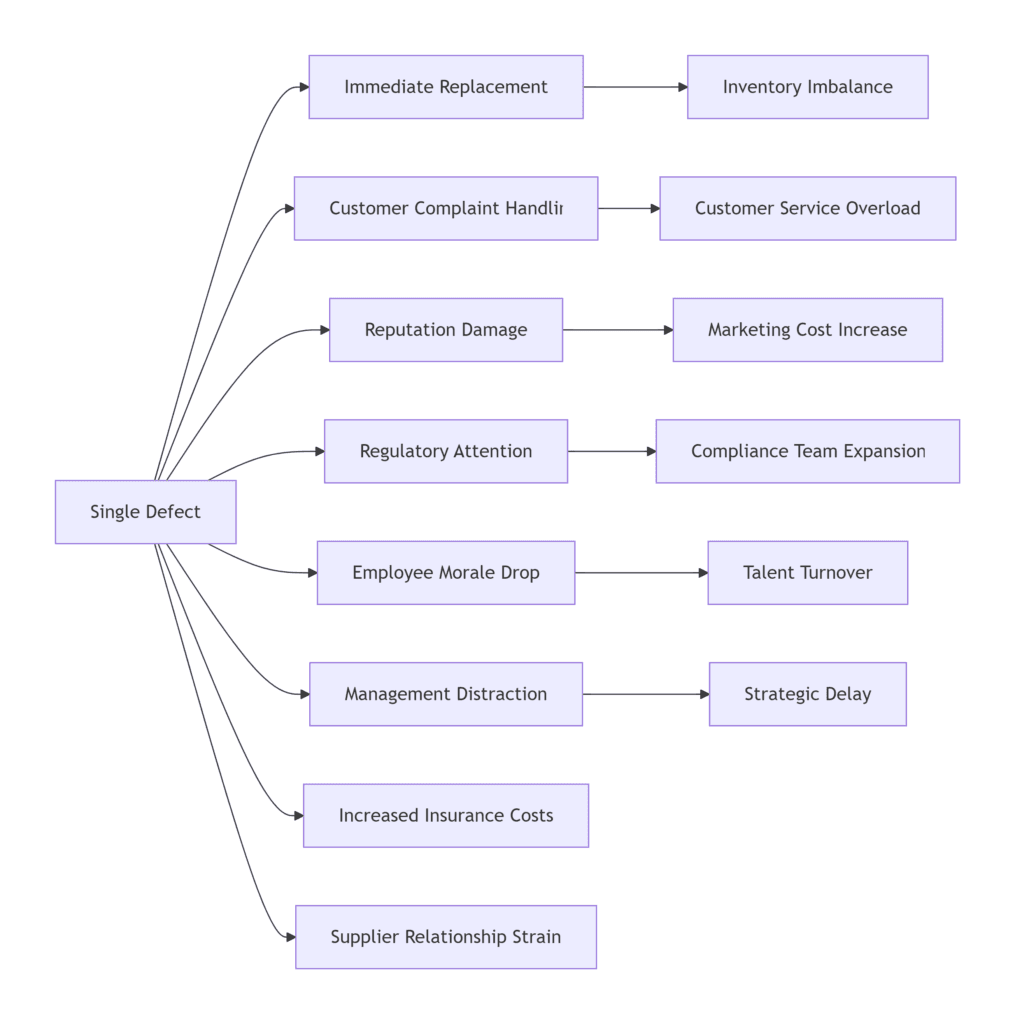
The Ripple Effect: How One Defect Creates Multiple Impacts
Measuring What Matters: Beyond Basic Metrics
Forget just tracking “defect rates.” Start measuring:
1. Cost of Quality (CoQ) Ratio
CoQ = (Prevention + Appraisal + Failure Costs) / Total Revenue
Benchmark: Under 10% is competitive in UAE/KSA markets.
2. Customer Lifetime Value Impact
Calculate how quality failures shorten customer relationships and reduce lifetime value.
3. Employee Engagement Correlation
Track how quality focus affects retention, especially critical in the GCC’s competitive talent market.
The Strategic Advantage in GCC Markets
Companies mastering quality management in the Middle East gain:
- Premium Pricing Power: Ability to charge 15-30% more
- Regulatory Favor: Faster approvals, fewer inspections
- Talent Magnet: Attract top performers wanting to work for excellence
- Partnership Priority: Become preferred suppliers to government and large corporations
A 90-Day Action Plan for UAE & KSA Businesses
Month 1: Assessment & Awareness
- Calculate your true Cost of Poor Quality (not just visible costs)
- Conduct customer interviews about quality perceptions
- Benchmark against regional competitors
- Train leadership on hidden quality costs
Month 2: System Implementation
- Implement preventive quality measures
- Redesign key processes with quality gates
- Enhance supplier quality requirements
- Start daily quality briefings
Month 3: Cultural Transformation
- Reward quality improvements, not just cost reductions
- Share quality stories and impacts company-wide
- Implement quality metrics in performance reviews
- Celebrate quality wins publicly
The Ghalib Consulting Difference: A Regional Perspective
Having worked with manufacturing, logistics, and service companies across Saudi Arabia and the UAE, we’ve identified regional specifics:
UAE Challenges:
- Rapid scaling sometimes outpaces quality systems
- Diverse workforce requires customized training approaches
- High customer expectations in luxury and service sectors
KSA Challenges:
- Supply chain complexities in remote locations
- Navigating evolving Vision 2030 standards
- Balancing tradition with modern quality methodologies
Conclusion: Quality as Your Competitive Shield
The true cost of poor quality isn’t an accounting exercise. It’s a strategic wake-up call. In the competitive markets of the Middle East, where reputation is currency and relationships drive business, quality failures don’t just cost money – they cost future opportunities.
The most successful companies in Riyadh, Jeddah, Dubai, and Abu Dhabi aren’t those who avoid defects. They’re those who recognize that quality excellence creates:
- Customer loyalty that survives price competition
- Employee pride that reduces turnover
- Operational efficiency that boosts margins
- Brand strength that opens doors
Your quality investment today isn’t an expense – it’s your most powerful insurance policy and growth accelerator combined.
📊 Ready to Calculate Your True Cost of Poor Quality?
Ghalib Consulting offers a proprietary Quality Cost Diagnostic specifically designed for UAE and Saudi businesses. In just two weeks, we’ll help you:
- Identify hidden quality costs in your operations
- Quantify their impact on your bottom line
- Prioritize fixes with the highest ROI
- Implement a sustainable quality excellence framework
Don’t let hidden defects silently drain your profits. Contact us today for a complimentary diagnostic session and discover how much quality excellence could be saving – and earning – for your business.