Phone: +971 50 162 0135
Email: ghalib@ghalibconsulting.com

 Byadmin
Imagine your business is a ship setting sail from the vibrant ports of Dubai or the industrial hubs of Al Khobar. You have a destination: market leadership, increased profitability, or regional expansion. For decades, the captain’s command was simple: “Follow the plan.” This plan was a detailed, step-by-step map, charting a single, unwavering course.
But what happens when an unexpected storm (a market shift) appears? What if a new, faster current (a technological disruption) emerges? Your rigid plan becomes a liability. You’re so focused on sticking to the prescribed route that you miss opportunities to sail with the wind or avoid danger altogether.
This is the fundamental difference between a plan and a roadmap. One is a static document designed for execution. The other is a dynamic compass designed for navigation and growth. In the fast-paced economies of the UAE and Saudi Arabia, where Vision 2030 and Dubai D33 are constantly reshaping the landscape, understanding this distinction isn’t just academic—it’s a strategic necessity for survival and success.
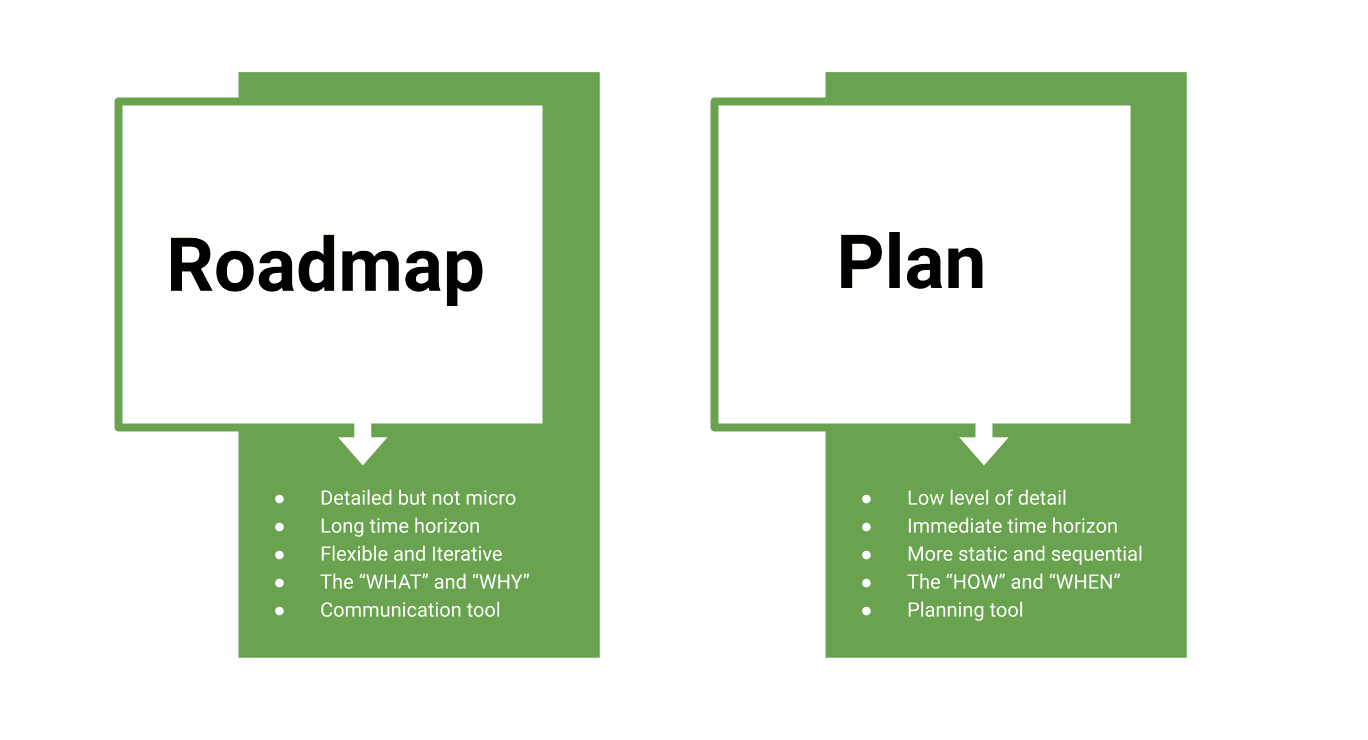
A plan is a familiar concept. It’s a detailed, tactical document that answers the questions: What are we doing? and When will we do it?
Think of a plan as the architectural blueprint for a building. Every wall, wire, and pipe is specified. Deviating from the blueprint is seen as a failure. In business, an annual budget is a classic example of a plan. It dictates spending for the next 12 months, often with little room for adjustment.
The problem? The business world, especially in growth markets, no longer resembles a predictable construction site. It’s more like open ocean sailing.
A roadmap, in contrast, is a strategic communication tool. It answers the questions: Why are we going there? and What are the key milestones along the way?
A roadmap is the captain’s chart. It shows the destination, key ports of call (milestones), and potential hazards. The captain still has to adjust the sails daily for wind and weather. In business, a product roadmap or a strategic growth roadmap visualizes how a company intends to achieve its vision over time.
This table clarifies the core difference between a plan and a roadmap at a glance:
| Feature | The Plan (The Blueprint) | The Roadmap (The Compass) |
|---|---|---|
| Nature | Static, Tactical | Dynamic, Strategic |
| Focus | Outputs (Tasks, Deadlines) | Outcomes (Goals, Value) |
| Timeframe | Short-to-Medium Term (e.g., 1 Year) | Medium-to-Long Term (e.g., 1-3 Years) |
| Flexibility | Low. Change is seen as a failure. | High. Change is expected and managed. |
| Audience | Internal Teams (for execution) | Internal & External Stakeholders (for alignment) |
| Key Question | “How and when do we complete these tasks?” | “Why are we going here and what will we achieve?” |
Consider a FinTech startup in the DIFC. Their plan for Q1 might be: “Hire 5 developers, build feature X by March 31, and allocate $100,000 for marketing.” This is essential for execution.
However, their roadmap would articulate: “Become the leading payment solution for SMEs in the UAE by 2026. Key milestones include securing a strategic partnership with a local bank, achieving 10,000 active users, and expanding into the Saudi market.”
If a new regulation emerges or a competitor launches a disruptive feature, the plan might need to be thrown out. The roadmap, however, remains valid. The team can pivot their tactics—perhaps delaying one feature to accelerate another—while still progressing toward the ultimate goal. This agility is what the Harvard Business Review calls a hallmark of adaptive strategy.
In the Middle Eastern business landscape, characterized by ambitious national visions and rapid economic diversification, a roadmap is not a luxury—it’s a critical tool for growth.
The difference between a plan and a roadmap is the difference between managing and leading. Management is about executing the plan efficiently. Leadership is about setting a direction and navigating the journey, even when the path is unclear.
A plan tells you how to build the ship. A roadmap inspires your crew, points toward the horizon, and gives you the confidence to navigate whatever seas you encounter. In today’s market, you need both. But without the strategic direction of a roadmap, even the most perfectly executed plan can lead to the wrong destination.
Is your business navigating with a rigid plan or a dynamic roadmap?
FP&A Services UAE & KSA | Financial Planning & Analysis | Ghalib ConsultingAt Ghalib Consulting, we help businesses across the UAE and Saudi Arabia transition from static annual planning to agile, outcome-driven roadmapping. We provide the strategic Financial Planning & Analysis (FP&A) framework that turns your vision into an actionable and adaptable growth journey.
Contact us today for a free consultation. Let’s chart a course for your sustainable growth.