Phone: +971 50 162 0135
Email: ghalib@ghalibconsulting.com

 Byadmin
Picture this: two businesses in the same Dubai free zone, selling similar products. One is scrambling to make payroll each month, while the other is steadily expanding, opening a new showroom in Riyadh. What’s the difference?
It’s rarely a secret magic bullet. More often, it’s a fundamental understanding of the Profitability Equation.
Most business owners think of profit as a simple result: Revenue – Costs = Profit. While mathematically true, this view is passive. It’s like hoping the weather will be nice tomorrow.
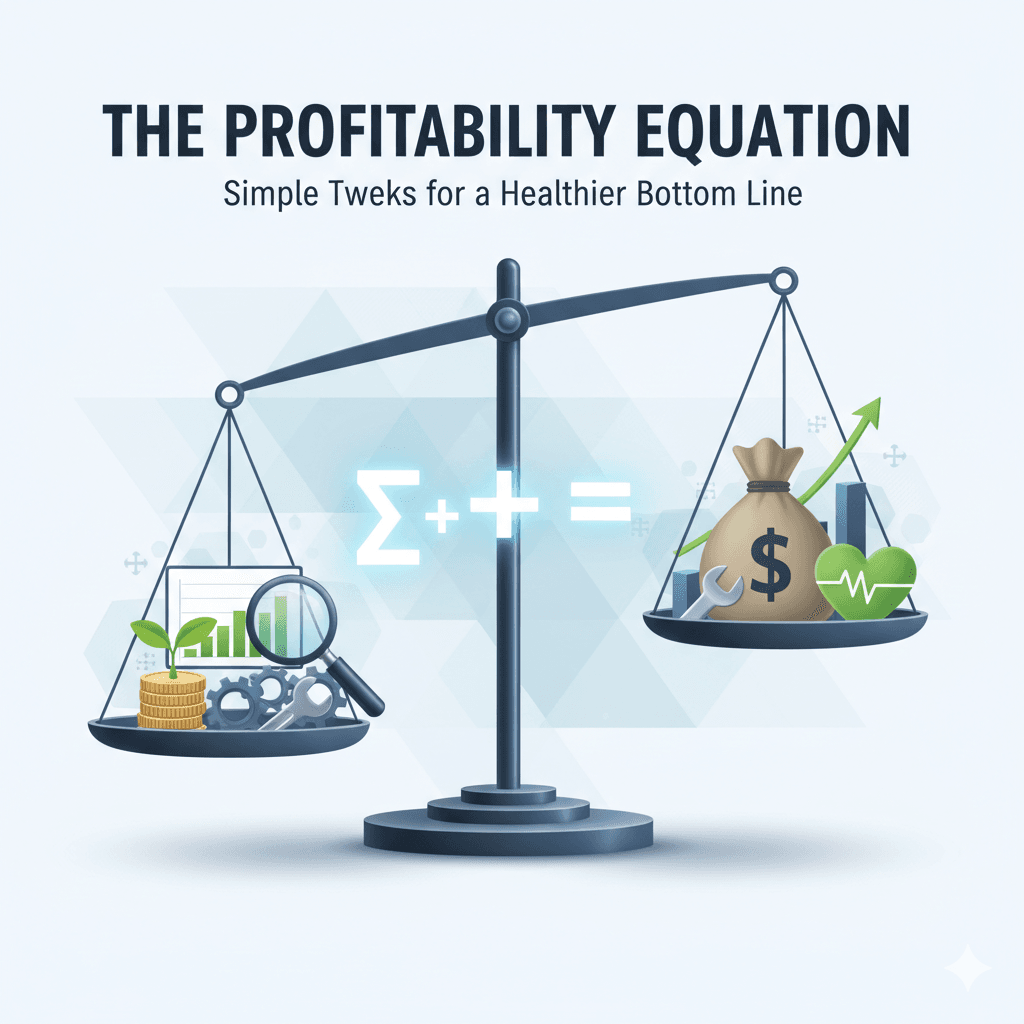
The proactive Profitability Equation is a dynamic framework: Profit = (Value Perception × Revenue Levers) – (Strategic Costs + Waste).
This shift in perspective—from a static calculation to a strategic engine—is what separates thriving businesses from surviving ones. Let’s break down this equation and explore the simple, powerful tweaks you can make to each component.
Most growth strategies start here: “We need more sales!” But brute-force selling is expensive and exhausting. The real leverage is in enhancing the variables within your control.
In price-sensitive markets like the UAE and KSA, the instinct is to compete on cost. This is a race to the bottom. The winning strategy is to make your price irrelevant by elevating perceived value.
Revenue isn’t a single lever you pull; it’s a series of interlocking gears. Focusing only on “new customers” ignores the immense value already sitting in your ledger.
| Revenue Lever | Common Oversight | Simple Tweak |
|---|---|---|
| New Customers | Chasing any lead, regardless of fit. | Implement a Ideal Client Profile to improve sales efficiency and retention. |
| Average Order Value | Not guiding the customer. | Use tiered pricing or “complementary product” prompts at checkout. |
| Purchase Frequency | The “out of sight, out of mind” problem. | Create a customer loyalty program or a subscription model for consumables. |
| Customer Retention | Ignoring the cost of churn. | Launch a proactive “check-in” cadence, not just a “renewal reminder.” |
A 5% increase in customer retention can increase profits by 25% to 95%, according to research by Frederick Reichheld of Bain & Company. The math is undeniable.
The traditional approach to a profit squeeze is to slash costs across the board. This often damages morale, quality, and future growth capacity. Strategic cost management is about differentiation.
Not all costs are created equal.
The Action: Conduct a “Waste Hunt.”
Your employees are often the first to see waste and inefficiency, but they rarely have a channel to report it or an incentive to care.
You can’t manage what you don’t measure. For many SMEs, the balance sheet and P&L statement are historical documents, not strategic tools.
| Business Type | Example Lead Indicator | Why It Predicts Profit |
|---|---|---|
| Consultancy | Proposal Win Rate | Predicts future revenue pipeline and utilization rates. |
| E-commerce | Customer Acquisition Cost (CAC) | If CAC is rising, future profitability on new sales is falling. |
| Construction | Project Margin vs. Estimate | Early warning that a project is becoming unprofitable. |
By tracking lead indicators, you can make course corrections before they show up as a problem on your bottom line. This is the essence of proactive financial management.
Imagine a Abu Dhabi-based digital marketing agency.
The Profitability Equation isn’t a one-time fix. It’s a continuous, mindful practice of aligning every part of your business—from how you talk about your value to how you manage a subscription—with the goal of sustainable profit.
Stop just calculating your profit and start engineering it. Look at your business through this new lens today. Ask yourself and your team: Where can we enhance value? Which revenue lever can we polish? What is truly waste?
The answers are already there. You just need the right equation to find them.
The tweaks in this article are a powerful starting point, but every business has a unique financial DNA. At Ghalib Consulting, we partner with SMEs in the UAE and KSA to conduct a thorough Financial Health Audit. We’ll help you identify your specific lead indicators, pinpoint hidden waste, and build a strategic plan to scale your profitability sustainably.
Don’t just hope for a better bottom line. Engineer it. [Contact Ghalib Consulting for a Free Discovery Call Today.]